Csaba Tibor Palotás: Original Oil Paintings
Step inside. These original oil paintings are hung in five virtual rooms, each with its own question: about stillness, about the body, about what’s left when the noise stops. Take your time. Walk through slowly, the way you would in a gallery, and stay with whatever stops you.
ROOM I: THE SEARCH
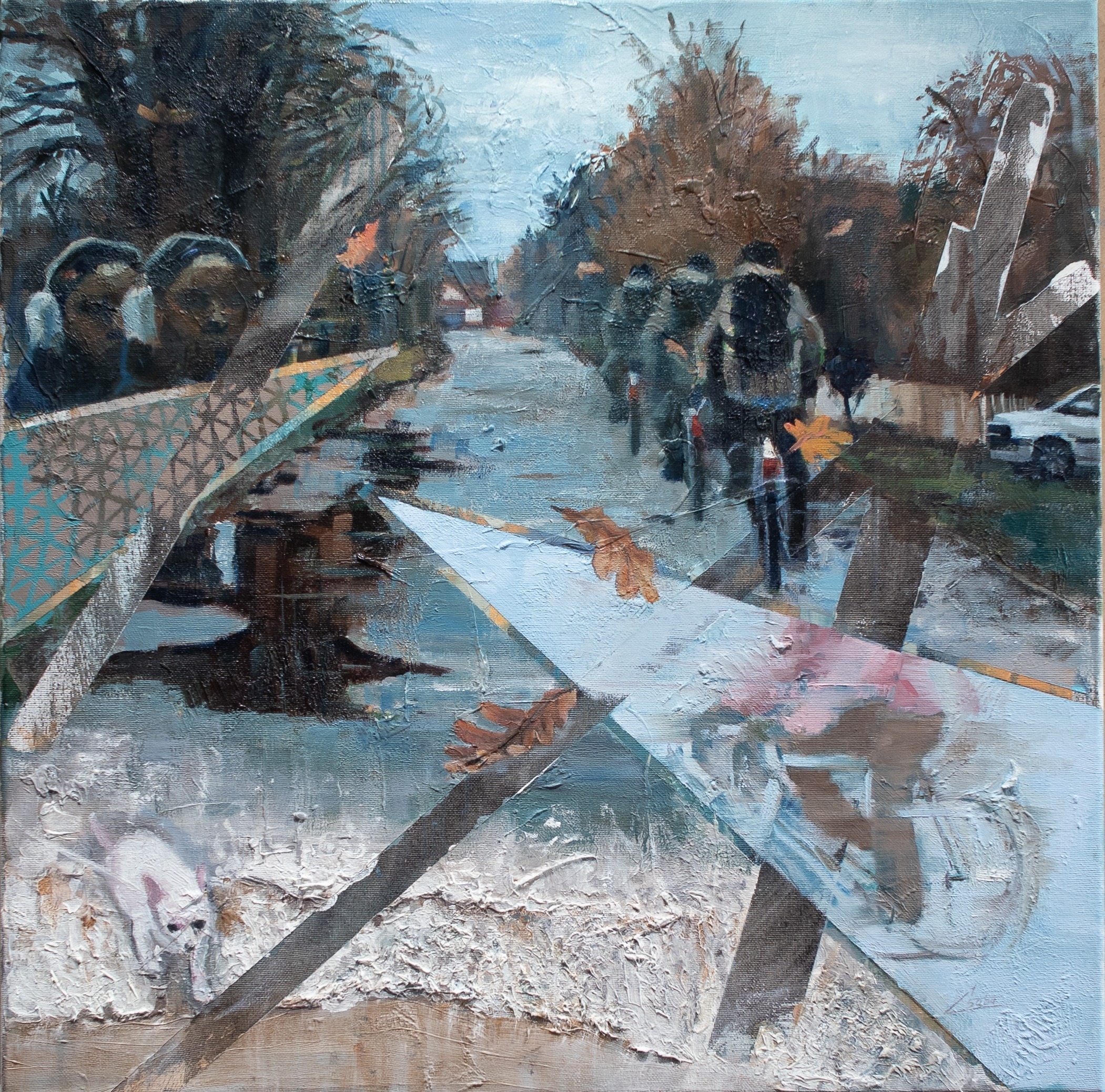
Rest in Motion
Oil on Canvas | 60cm x 60cm
"The only rest that you can achieve in this universe is finding your peace by quieting your mind."
Artist's Journal
"This painting is about the notion of motion. The entire universe is in motion. Every cell and every atom vibrates, resonates, and is moving all the time.
When you sit comfortably at your home or lie on the sofa, the whole earth travels at the speed of 107,000 kilometres per hour (67,000 mph) around the sun. By comparison, a bullet travels around 3,000 kilometres per hour (1,800 mph). The universe is in a constant state of motion, allowing no repose. We scarcely feel anything from all of this.
We strive to keep things from changing by continuously trying to fix, stabilise, or insure them. This task feels like an endless endeavour similar to that of Sisyphus. Our mind doesn't rest either. It runs marathons a couple of times a day. Usually, it only switches off if we sleep or if we are knocked out.
The only rest that you can achieve in this universe is finding your peace by quieting your mind.
That is something we all yearn for. Attaining a state of a quiet mind is possible, but it needs to be found."
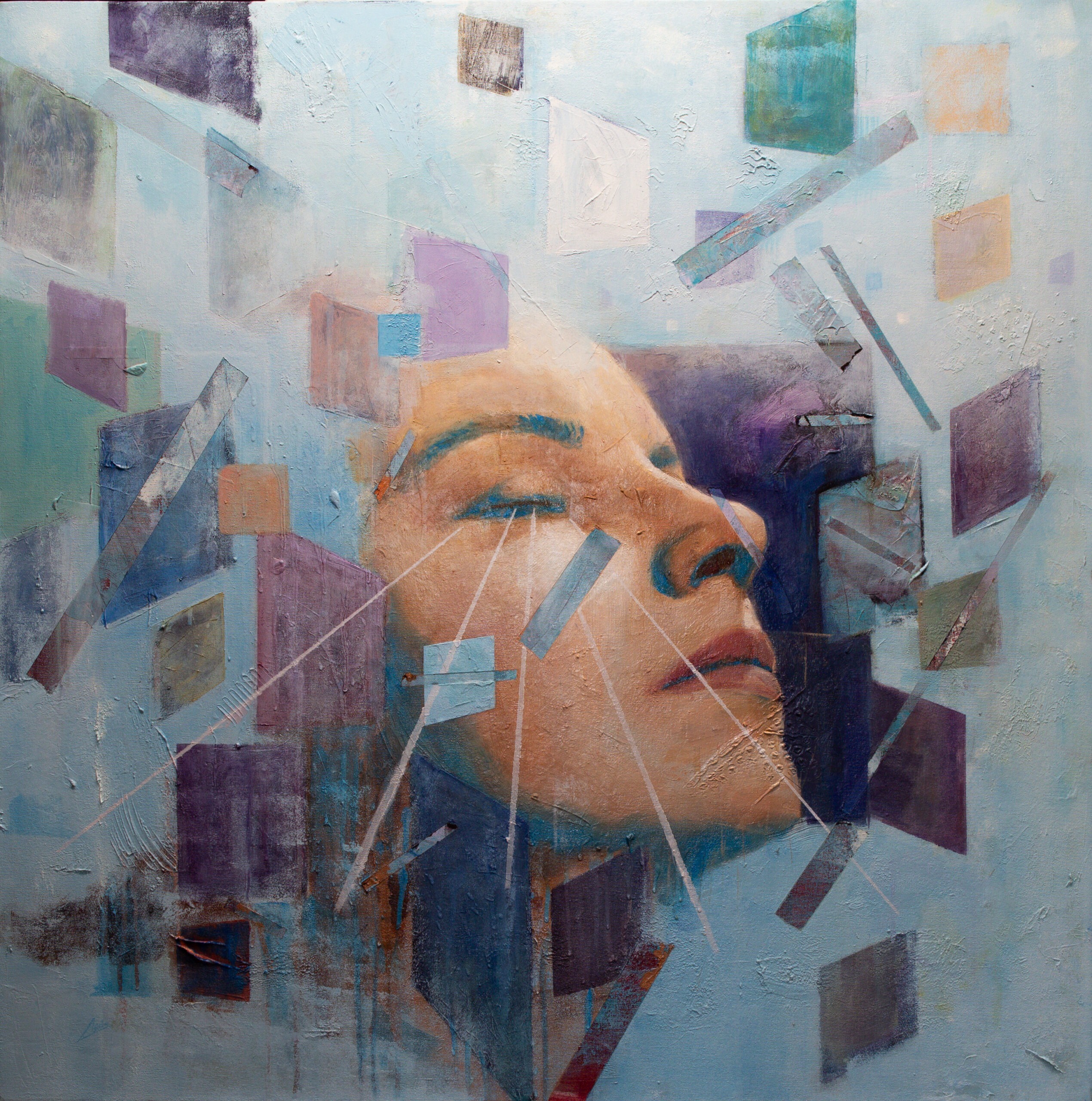
INTEGRITY OF NOW
Oil on Canvas | 100cm x 100cm
"Integrity is a commonly used word in business circles, but it also holds spiritual significance: the state of being whole and undivided."
Artist's Journal
Our senses have a limitation. There are colours we can't see; there are sounds we can't hear; there are smells we can't smell; there are tastes we are unable to taste; and of course there are things we can't touch—and yet we are rooted in this universe.
This bond is the basis of our being. Our mind works only within its limitations and creates our reality for us.
The essence of integrity lies in recognising a humbling effect that arises from understanding a deeper, broader, and higher connection beyond our thinking mind.
It can happen only in the now, and the other name for it is Presence.
The masking tape marks imply the mind's layered nature and the option to remove specific layers.
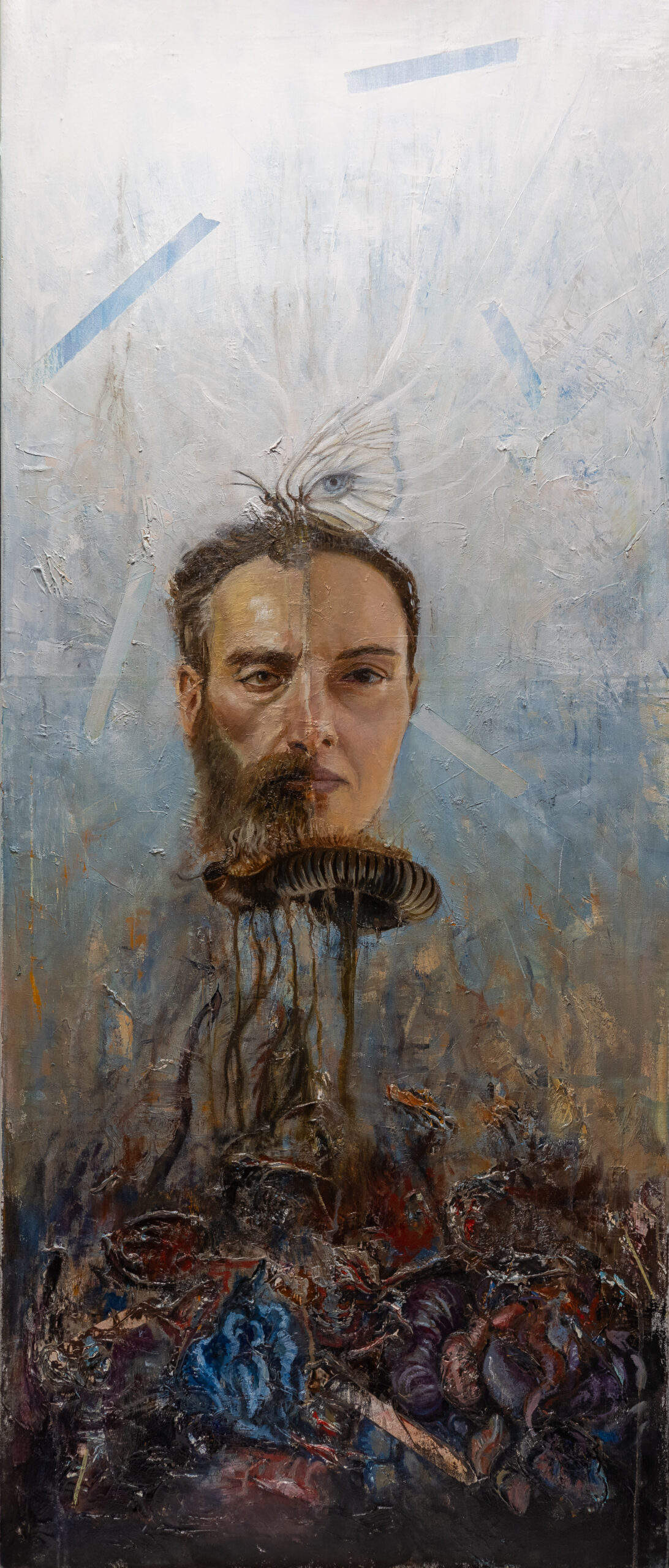
THE VERTICAL LINE
Oil on Canvas | 62cm x 142cm
“We live our lives on two layers: the thinking layer, which we identify with, and the being layer, which is our ground.”
Artist's Journal
We live our lives on two layers. We have the thinking layer, which we are mostly identified with. We rarely analyse thinking as a layer, but if we zoom out and look from an observer's point of view, we can see that thinking is happening to us, rather than being generated by us.
It operates like breathing: we can control it to some extent, but mostly it just happens. When a "bad" thought arises, we often feel we are a "bad" person because we assign ownership to it. But we did not choose the thought; it simply appeared.
Thinking is an evolutionary development. It is our advantage, and our mind is our most prized asset. Yet, it can also move us to our downfall. Obsessive thinking overwhelms us. We seek happiness, and we seek a way out.
Often, the most available option to reduce the thinking is the use of substances to "numb ourselves," or to focus on pleasure chasing. But there is a layer beyond the thinking: the being layer.
The root that is our life force, our ground—this is the being layer. On this level, conceptual thinking is useless. The time is now, and the space is here.
The painting depicts a half-male, half-female portrait, representing the human being as a whole. According to Jung, we all carry both masculine and feminine aspects within our psyche—it is the Yin and Yang with faces.
This duality is defined by a vertical conflict. The centipede at the bottom symbolises the downward pull: the misery, the suffering, the constant reaction, the loss in the visceral mess, the rolling in the dirt. It is the weight of the unconscious mind.
In contrast, the butterfly represents the upward movement of transformation. It carries our third eye—the observing, witnessing eye—the symbol of the being layer.
When we find our way to this layer, we rise above the noise of the centipede. We step out of the downward spiral. This is awareness, and this is a choice we can make.
ROOM II: THE CONFRONTATION
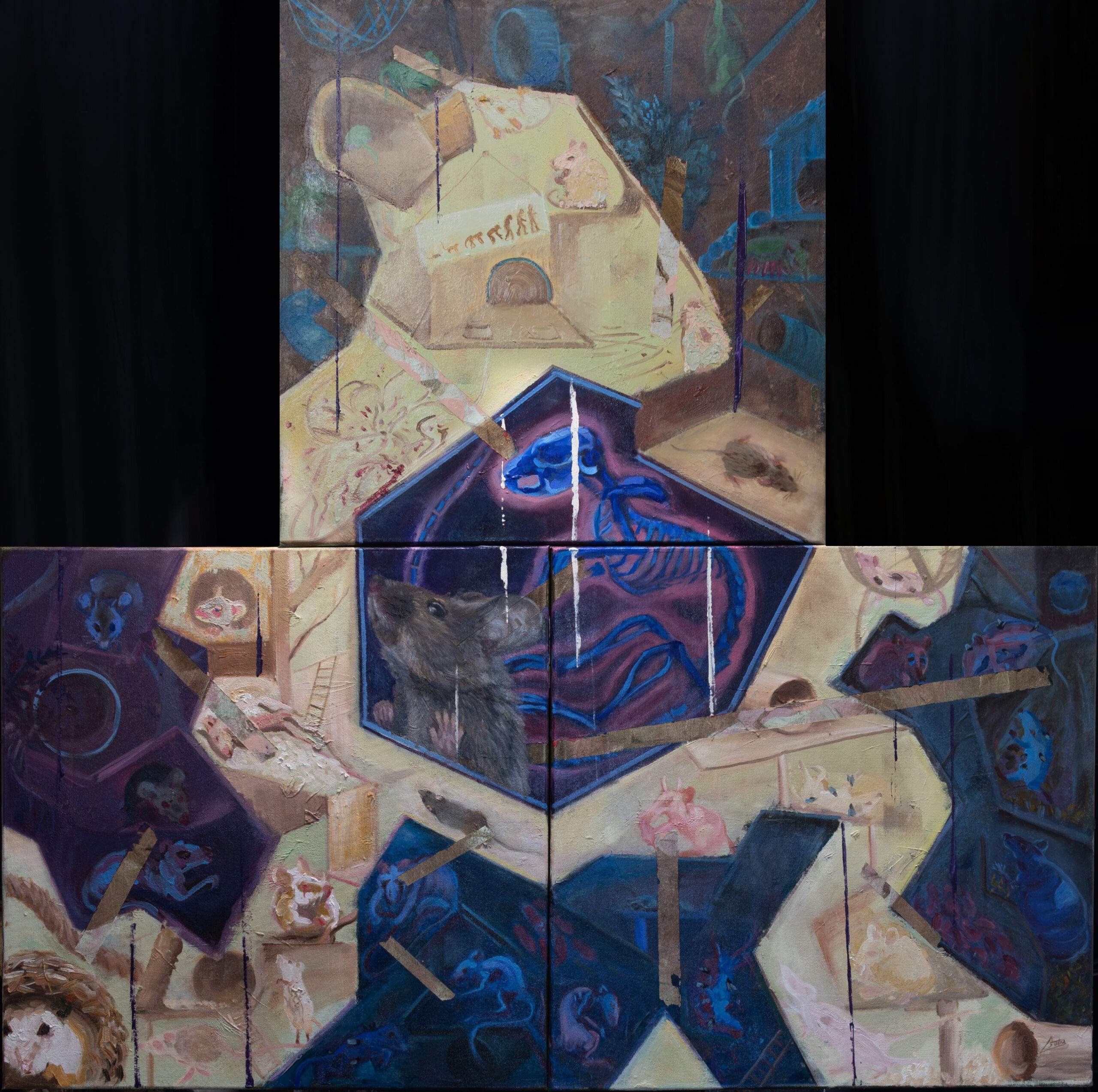
UNIVERSE 25 (BEHAVIOURAL SINK)
Oil on Canvas | 3 Panels (60cm x 60cm each)
“Though mice couldn't evade this fate, it prompts us to ponder the potential implications for human society. Can we counteract these societal influences?”
Artist's Journal
In 1968, American scientist John B. Calhoun conducted a series of experiments involving rodents, initially using Norwegian rats and later transitioning to mice. He ensured they had all necessary provisions, including ideal conditions, food, water, and protection from natural predators and diseases. The sole aspect he limited was their living space, focusing his research on the effects of overcrowding.
Initially, things seemed to go well, but chaos soon ensued. As living conditions became more cramped, the animals exhibited increasing levels of violence. They displayed abnormal sexual behaviours, turned on their own offspring, or entirely neglected them.
Over time, the females grew more aggressive, isolated, and disinterested in reproduction. The problem exacerbated with each new generation, and even when removed and placed in a healthier mouse society, the adult mice with abnormal behaviours couldn't reverse the effects.
The entire mouse society, which began with just four individuals and peaked at around 2,200, ultimately collapsed and could not recover. Repeated experiments yielded the same outcomes, and Calhoun termed this phenomenon the "behavioural sink."
Though mice couldn't evade this fate, it prompts us to ponder the potential implications for human society. In its early stages, the human embryo closely resembles that of a mouse, fish, or frog. The extinction of dinosaurs paved the path for mammals to evolve from their small, mouse-like ancestors into the diverse species we observe today.
The intention behind this painting is not to proclaim moral superiority or depict a doomsday scenario, but rather to provoke contemplation about the impact of society on individuals.
Societies are shaped by the desires of the masses or the majority, whether those desires are positive or negative. Cultivating an internal spiritual compass can serve as a means to counteract these societal influences.
While we are inherently social beings, each individual also has a fundamental requirement for solitude and personal space. But the most remarkable aspect of being human lies in our capacity to transcend ourselves. Animals can’t do that.
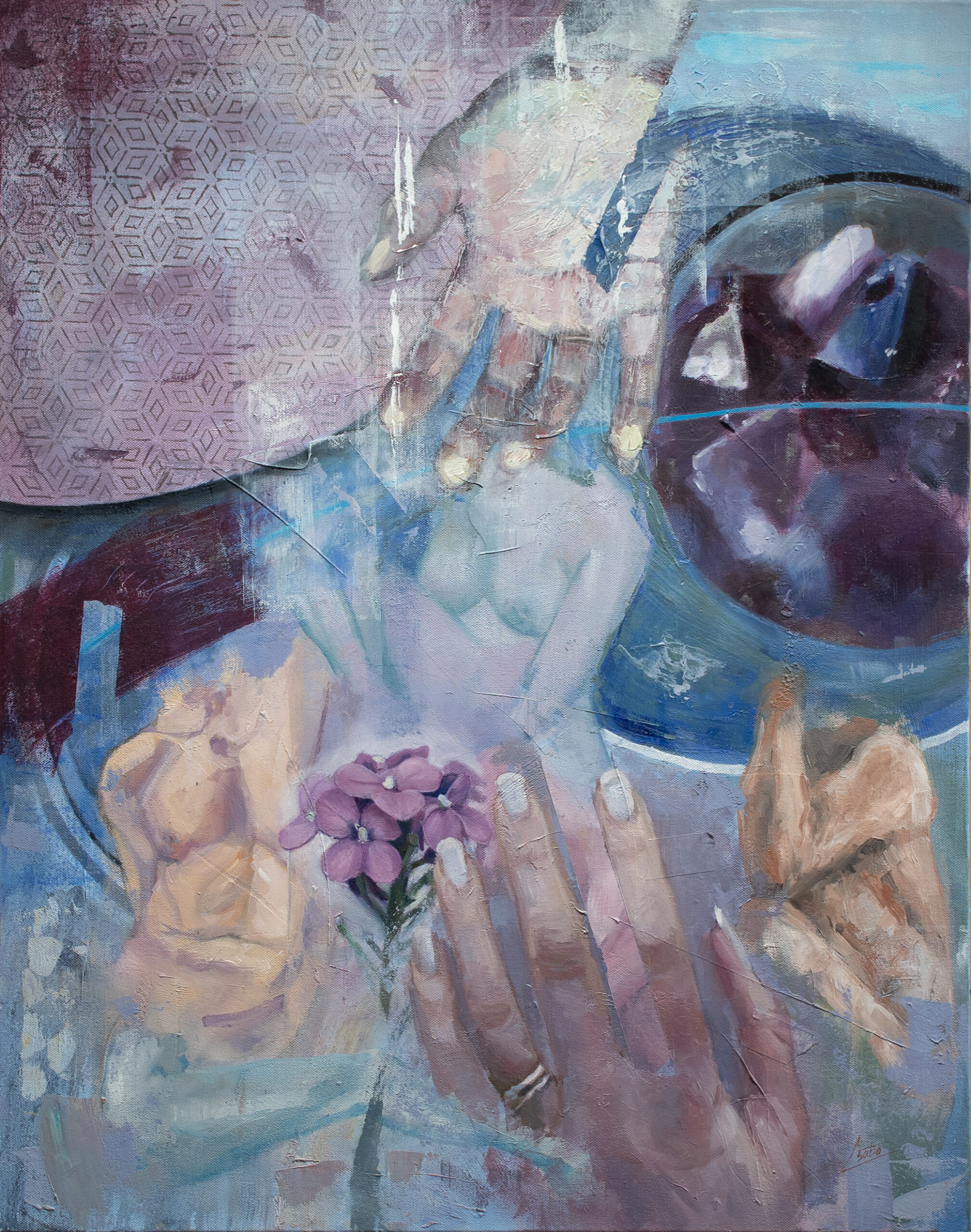
HANDS HOLDING THE VOID
Oil on Canvas | 60cm x 76cm
“In my earlier years, I went to great lengths to evade the sensation of emptiness. Today, I embrace it.”
Artist's Journal
I borrowed the evocative title for this painting from Giacometti, the renowned painter and sculptor. Each word in the title holds significance within my artwork.
In my earlier years, I went to great lengths to evade the sensation of emptiness. I busied myself to fill that void. Today, I embrace it, recognising that it no longer carries a negative connotation.
Our minds crave constant engagement, entertainment, and stimulation. They are ceaselessly bombarded with decisions and information, rarely finding respite except during sleep or when sedated by substances.
The feeling of emptiness should not be confused with boredom, which entails a desire to do something without knowing what. Emptiness or void, in contrast, represents the stillness of the mind while awake, where the inner awareness halts the incessant chatter of thoughts. Its significance only becomes apparent on the spiritual journey.
This feeling of emptiness is not synonymous with loneliness; rather, it embodies the sense of space that all life, objects, and every atom share.
ROOM III: THE TURNING POINT
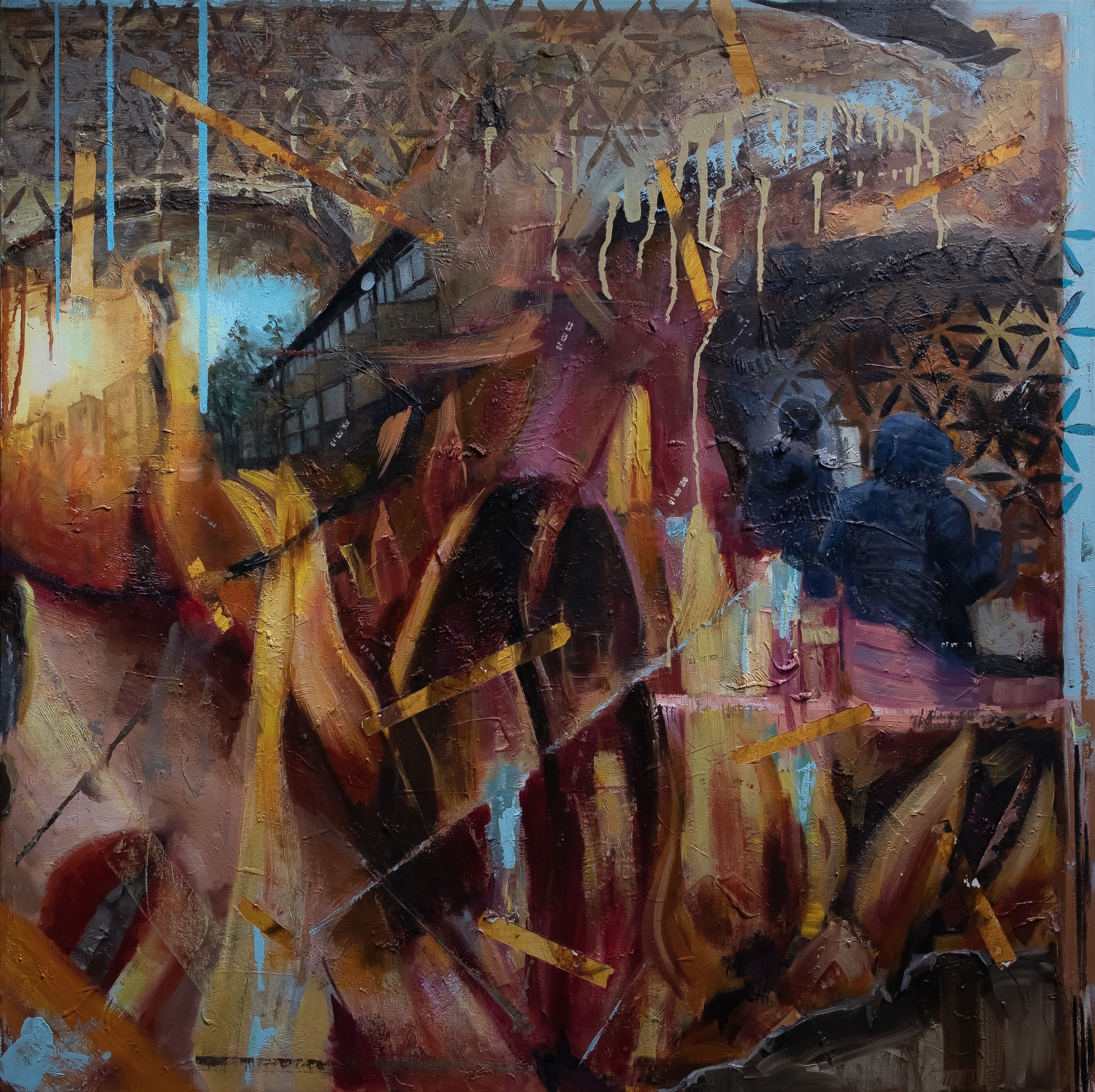
PERMANENT IMPERMANENCE
Oil on Canvas | 100cm x 100cm
“The sweet youthfulness turns into a dark bitterness of melancholy, and it burns. But this could be the turning point.”
Artist's Journal
Through life experience, sooner or later we run into the discovery that everything is in constant change and has an impermanent nature.
The body gradually starts to decay; we lose hair, teeth, eyesight, shape, health... the list can go on. We lose at life, relationships, roles… we lose beloved ones. The suffering grows, and we feel we are running out of time.
The sweet youthfulness turns into a dark bitterness of melancholy, and it burns. It burns us out. This could be the turning point.
While fire hurts, it gives us warmth to connect with others; it emanates light so that we can see what we have not seen yet. It cleans and makes room to renew. This is the opportunity to be humbled, to let burn the package of suffering we carry, to accept.
It is an opening of a spiritual path. It is the realisation that life is just as sweet as it has ever been for everyone and at any age. It’s not age restricted.
The ups and downs will come and go, but allow this burning to find what time can't touch, to see how time is healing, to learn what time is teaching. Appreciate your gift of being.
The masking tape marks hint at the brain's layered structure and the chance to peel off some layers.
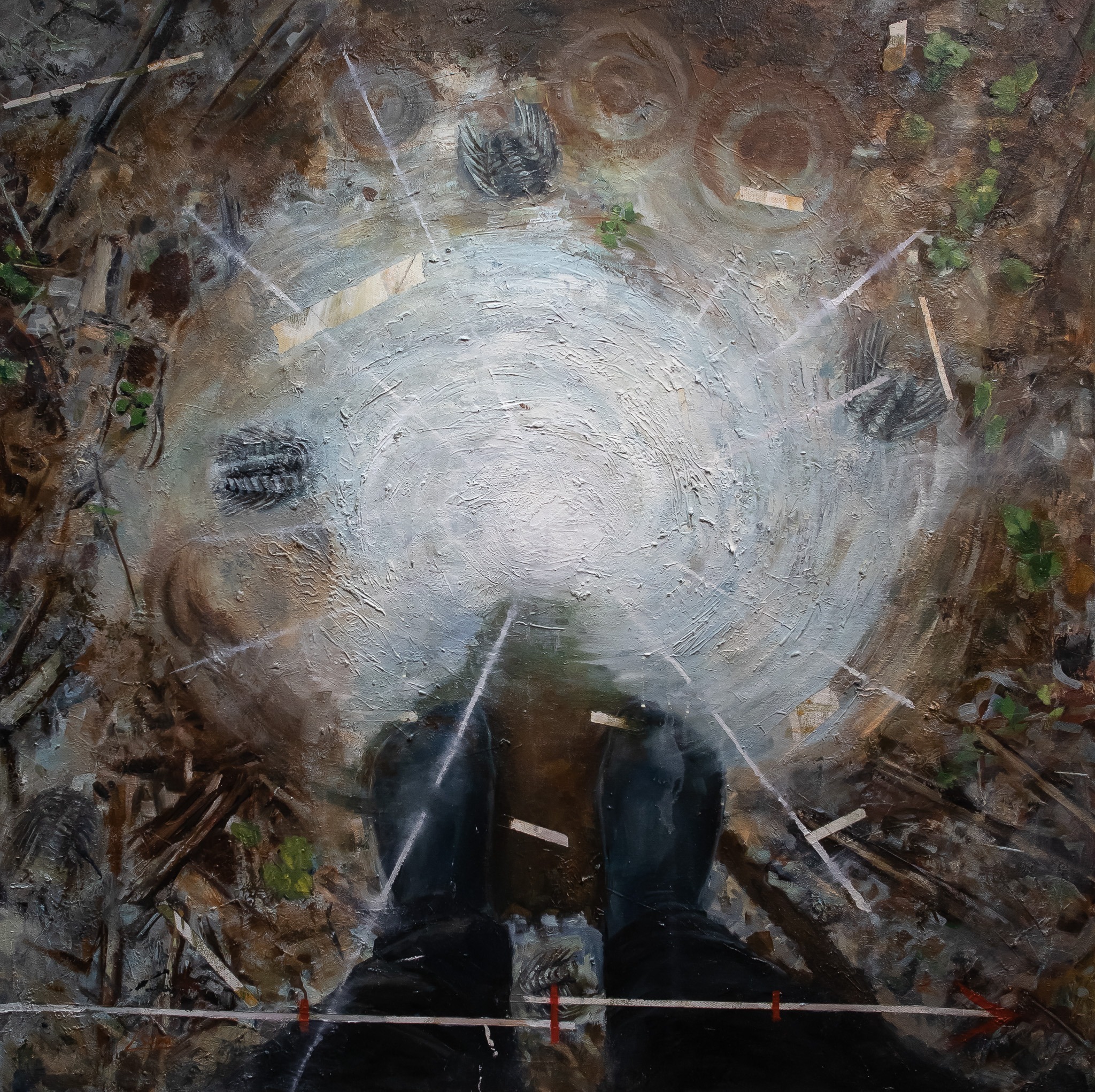
THE PORTAL TO THE NO-SELF
Oil on Canvas | 100cm x 100cm
“Why is it that when we look at a reflected image, we say that little shape of a head and body is 'me'?”
Artist's Journal
Reflection is how we see the world. The phenomenon of the mirror has stimulated artists for centuries and is central to the Buddhist tradition.
To bring this closer: imagine you are in a forest on a rainy day. You look down at a puddle and notice your reflection. But the reflection is not just you; it includes the sky, the trees, the clouds—the entire world around you.
Why is it that when we look at this image, we point to the tiny shape of a head and body and say, "That is me"?
The complete image is in your mind. Your consciousness holds the entire scene. In that moment, the "outside" world (the trees, the sky) appears inside your perception. You are never separated from it. As the old Zen saying goes: "The whole universe is one bright pearl."
It is impossible to exclude the external universe. You cannot detach from it. As awareness, you are it.
The ancient question this painting prompts is: Who am I?
If thoughts and images come and go like reflections in a puddle, then they are not you. In the Buddhist tradition, anything that arises and passes is not the True Self. The invitation here is to stop thinking and start feeling with pure sense perception. To experience awareness without the concept of "Me."
This is the approach to self-enquiry—the portal to the No-Self.
Note on the composition: The fossilised trilobites suggest the timeless quality of this portal, while the timeline at the bottom marks the fleeting present moment. The masking tape marks represent the mind's layered conditioning and the possibility of peeling it away.
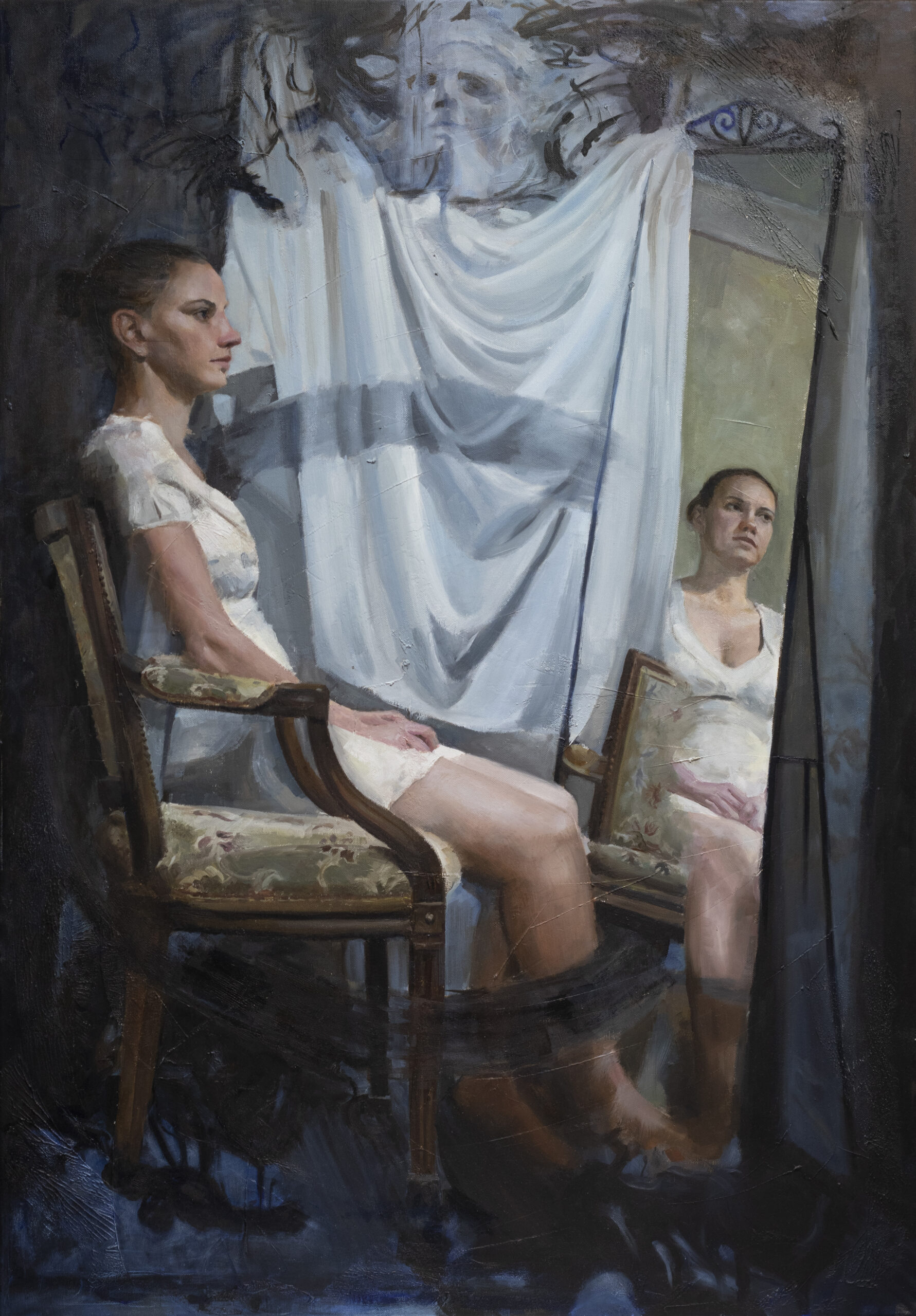
NONDUALITY
Oil on Canvas | 60cm x 76cm
"Our language is vague... it generalises and groups things together. But this grouping is a limitation. As we talk about beings, we single them out: this plant, this tree, this person.”
Artist's Journal
It means "not two" if we break it down to components. But why "not two" and why not just "oneness"? This is a common conceptual paradox that the name itself resolves in a very wise way.
It is not "one" because our body carries feelings, emotions, and thoughts that are individual, not seen or understood by others. It has a level of individuality, like everything else.
Everything has its own character: no two snowflakes are identical, no two leaves are the same, no two fibres of the carpet are the same.
Our language is very vague. It cannot name every object, every snowflake. Even if we numbered them, it would be chaos to talk about it. It generalises and groups things together.
But this grouping in our language is a limitation. As we talk about beings, we single them out: this plant, this tree, this person. Each and every one of them is unique, yet not separate from its environment.
As a concept, "oneness" is the all-inclusion of everything. Yet the phrase "not two" is a subtler resolve to point to the relationship rather than singling out one, or one and another.
In this painting, the girl is painted with her reflection in the mirror. But which one is which? As we look at people, we see their reflection. Our mind is the mirror, but the mirror is limited to the picture. Reality is not a picture.
We can't really peel ourselves from reality. Yet all we see is a reflection.
The girl in the painting disappears in some places and is revealed in others. This play with "in and out of visibility" is the suggestion of not one and not two. Similarly, it could include the manifested and unmanifested aspects of life.
In the middle, I painted a faint face—a classical sculpture—to symbolise liberation. When we liberate ourselves from the idea of separation, we touch nonduality.
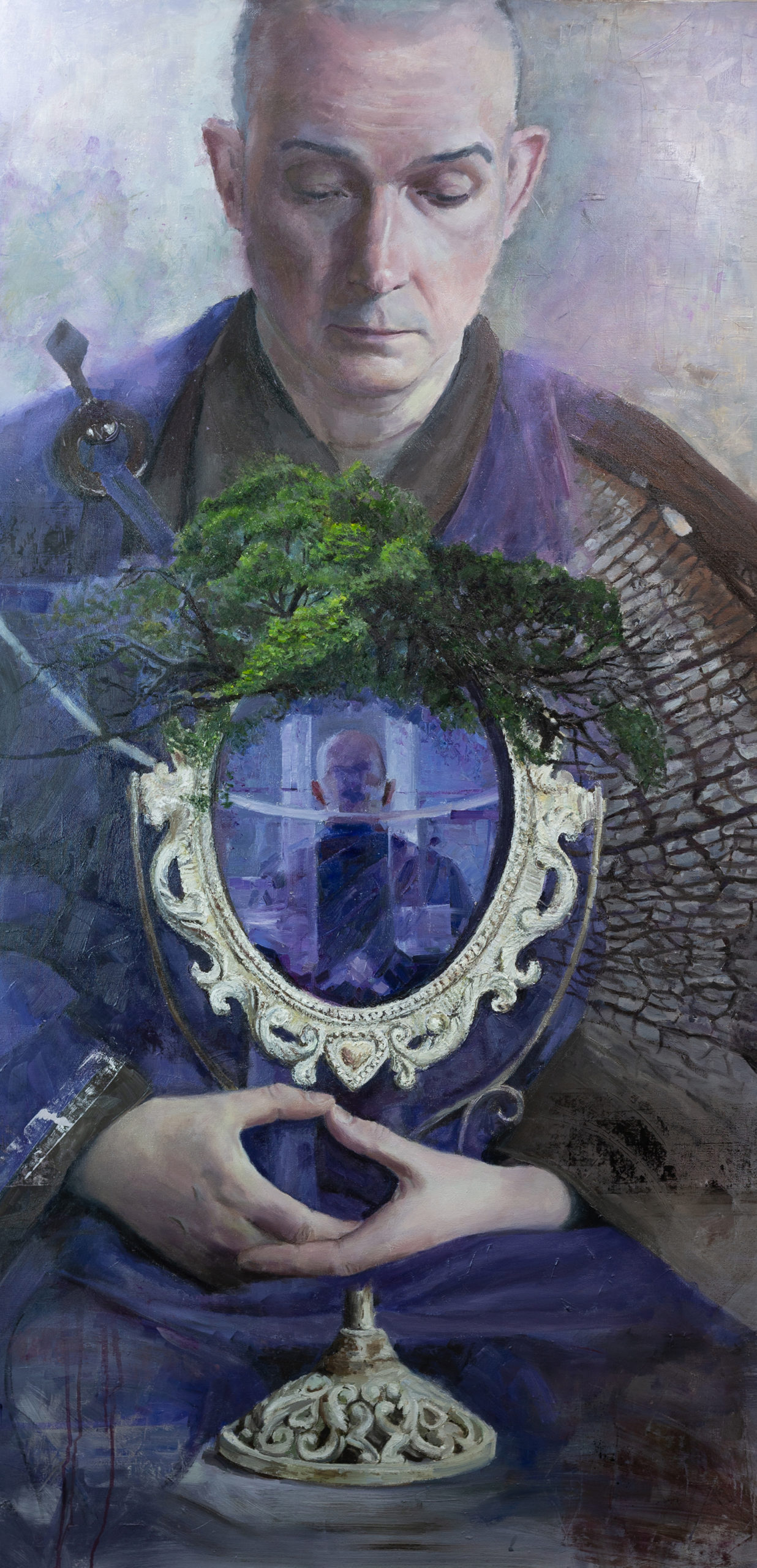
MONK, MIRROR AND TREE (PORTRAIT OF REVEREND WILLARD)
Oil on Canvas | 70cm x 156cm
“The body is the Bodhi tree. The mind is like a clear mirror stand... But logic dictates that a reflection is an illusion.”
Artist's Journal
Two people stand in front of the painting: a Viewer and the Painter.
Viewer: I see the Monk (Reverend Willard), but why is he surrounded by a tree and a mirror?
Painter: They refer to the famous contest to become the Sixth Patriarch of Zen. The head monk, Shenxiu, wrote a verse to demonstrate his understanding of the mind:
The body is the Bodhi tree, The mind is like a clear mirror stand. At all times we must strive to polish it, And must not let the dust collect.
Viewer: That makes sense. The mind works like a mirror. The eyes receive light, and the brain creates a reflection of the world "in here."
Painter: Yes, but follow the logic. If your experience is just a reflection, that means you only ever possess superficial information of reality. You see the surface of the apple, but never the apple itself.
Viewer: So, I am interacting with an image in my head, not the world itself?
Painter: Exactly. And the consequence is that your entire inner working—your identity, your ego—is based on that illusion.
Viewer: This is confusing. My logic says the reflection is fake, but my body says my feelings and thoughts are very real. How do I resolve this paradox?
Painter: I cannot resolve it for you. Concepts cannot solve a problem created by concepts. But the Sixth Patriarch, Huineng, offered a different perspective:
Bodhi originally has no tree, The mirror also has no stand. Fundamentally there is not a single thing, Where could dust arise?
Viewer: That sounds profound, but it feels harsh. "Not a single thing"? Am I not real?
Painter: This is the discovery you must make. There are three ways to look at this conflict.
1. You can accept Huineng’s verse: There is nothingness. The "Self" is a complete illusion, so there is no one to suffer.
2. You can see it as Pure Observation. The "Observer" (You) and the "Observed" (The Reflection) merge into one. There is no separation, only seeing.
3. Or, you can recognise that words fail here. The friction between "illusion" and "reality" is the point. You stop trying to solve it with your mind and just be with the paradox.
Viewer: Which one is the truth?
Painter: Which one opens the door for you?
Viewer: (Turns to you, the reader) This conversation took place in my head, and now in yours. The question is... how will you resolve it?
ROOM IV: THE AWAKENING
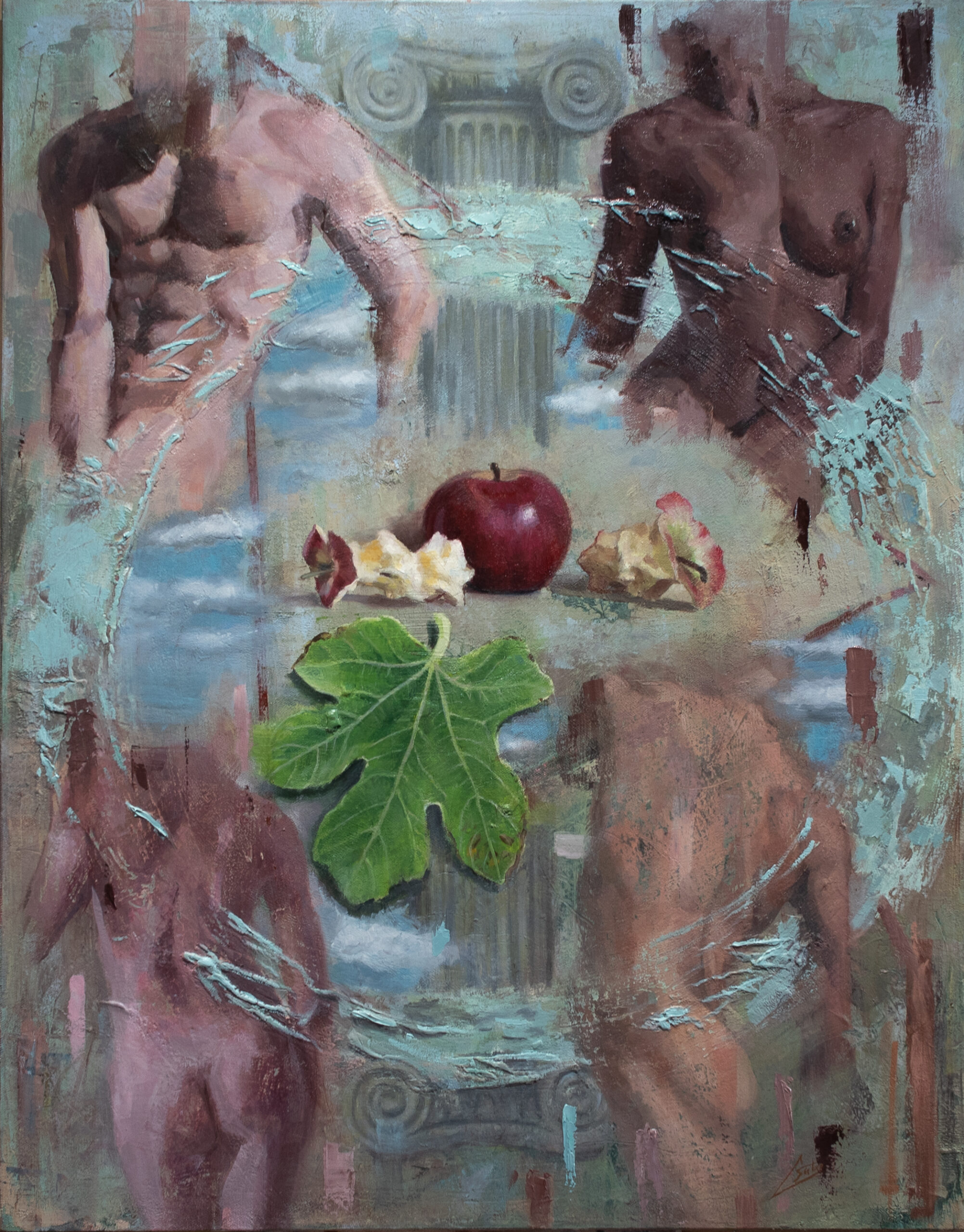
EVE AND ADAM
Oil on Canvas | 60cm x 76cm
“Let's imagine that the ‘forbidden fruit’ was not an apple, but the birth of the thinking mind. A remarkable tool, but one that came with a price.”
Artist's Journal
The Book of Genesis narrates the tale, how the initial human couple, Eve (ladies first) and Adam gambled away the Paradise.
They eat the forbidden fruit (apple through art history) in pursuit of the secret knowledge. This story is quite familiar to us all. Let's imagine that this secret knowledge pertains to the emergence of the thinking mind.
It's a substantial advantage over the animal kingdom, a remarkable tool if wielded wisely. However, it comes hand in hand with the birth of the Ego.
As a result, we become self-aware or shy and self-centred or selfish. Our inherent and eternal abundance transforms into a sense of lack, leading to insatiable desires and the advent of hard labour.
This rupture divides the once-eternal state of oneness, or Paradise, into two realms: the external and the internal worlds.
The sturdy pillar in the background symbolises the "I," representing the Ego. Certain spiritual traditions distinguish the "higher self" with a capital "I" and the Ego with a lowercase "i." Nevertheless, I prefer using a capital "I" for the Ego, aligning with the common convention in everyday writing.
Considering our understanding of the gradual evolution of the thinking mind, I have depicted four figures instead of the traditional two.
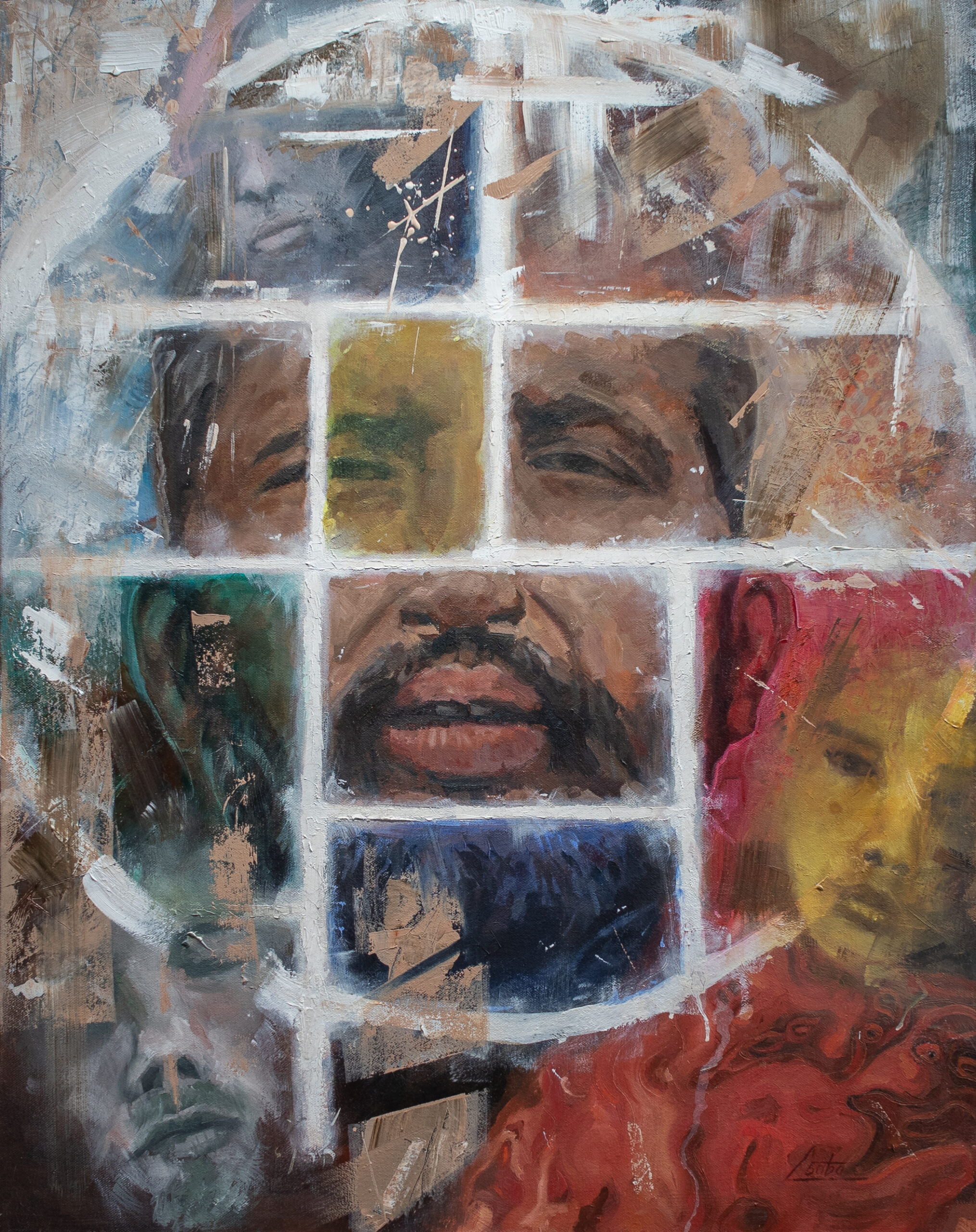
RAMAKRISHNA
Oil on Canvas | 60cm x 76cm
“Rejecting all religions entirely is akin to discarding both the valuable and the less valuable aspects.”
Artist's Journal
The portrait of Ramakrishna requires little explanation. He was a spiritual leader who passed away in his fifties, leaving a lasting legacy of inspiration. Ramakrishna's unique journey involved initiation into Hinduism, Christianity, and Islam, allowing all these religions to coexist harmoniously within him.
Each of these religions originates from a profound spiritual truth aimed at providing purpose, meaning, alleviating suffering, and fostering compassion in life.
Rejecting all religions entirely is akin to discarding both the valuable and the less valuable aspects. A wiser approach involves studying and uncovering the fundamental truths shared by all religions.
It falls to each new generation to unearth, cleanse, share, revitalise, and renew these deeply rooted, time-honoured truths. Ramakrishna serves as a shining example of this mission.
The painted faces surrounding him symbolise those who have been profoundly touched and inspired by his wisdom.
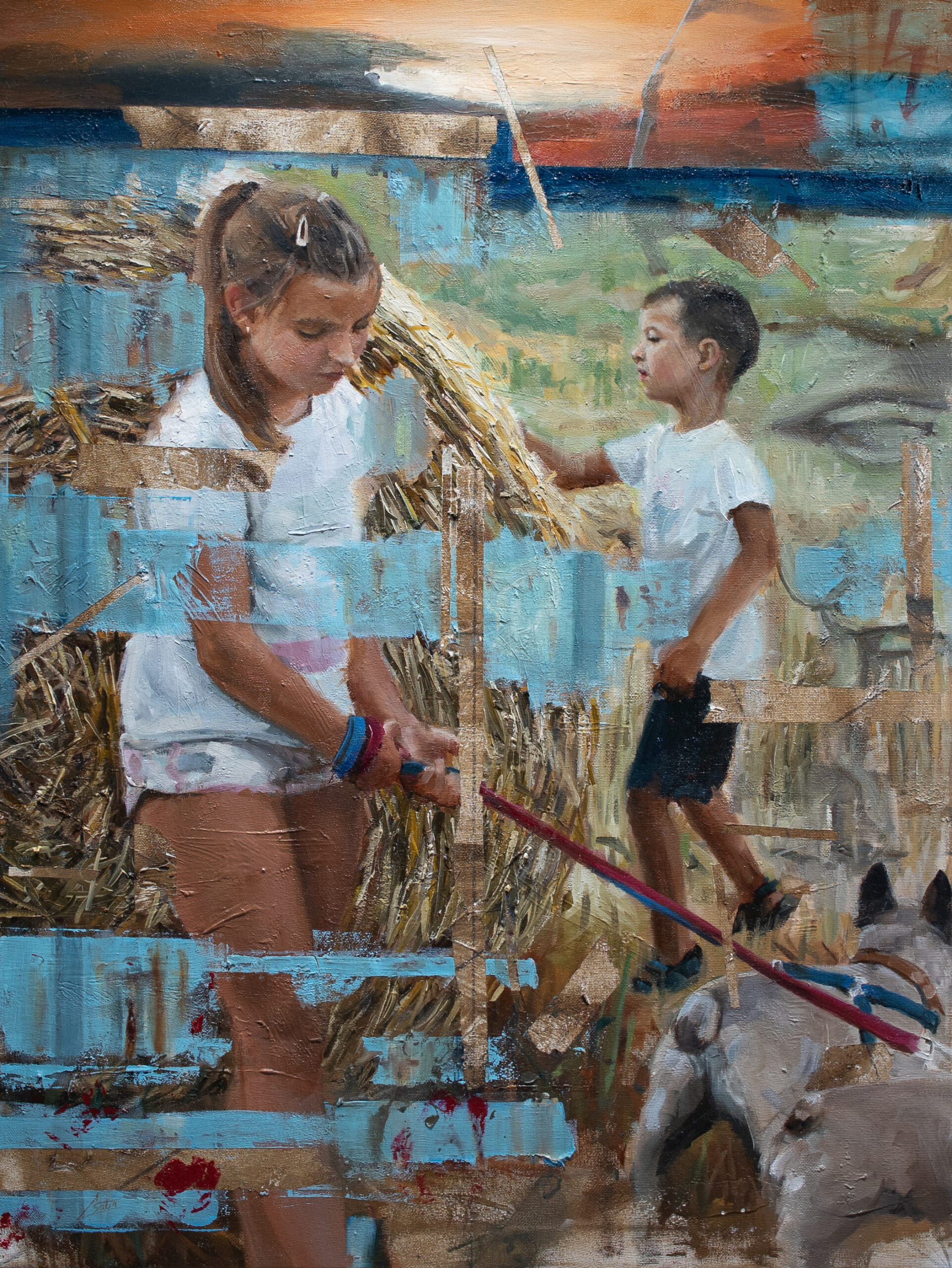
AN IMAGE REFLECTED ON THE CAVE OF THE EYEBALL WITH PLATO
Oil on Canvas | 60cm x 76cm
“One can easily distinguish the true world from its reflection in a mirror. But, what if one's perception is entirely based on a reflection?”
Artist's Journal
This picture depicts two children, with Plato hidden in the background. It began simply: a walk with my sister's kids and the dogs. I tried to direct them, suggesting poses, but the best shot came when I stopped directing.
I pretended to fiddle with my camera and let their attention wander. Soon they became occupied with their own world. It was all natural, no staging, just two children forgetting about themselves.
But the main idea lies in the title. The ancient Greeks already knew about the phenomenon we call the camera obscura. Light passing through a tiny hole in a dark room will produce an upside-down image on the opposite wall.
Plato likely knew this. In his Allegory of the Cave, he describes people chained, seeing only shadows on a wall and believing that is the whole world.
Let’s cross the camera obscura with the allegory of the cave. Light is incredible; it carries energy and it reflects itself. This reflection is what appears in the camera obscura.
So, what if the "play of shadows" is just the reflection on the wall of our mind?
Our eye is a biological camera obscura. The mind is bound to the reflection it creates, but the true chain is the identity formed by that mind. We can easily distinguish the true world from its reflection in a mirror. But what if one's entire perception is based on a reflection?
The emphasis of the story is that Reality is reduced to images, sounds, smells... it is a massive reduction. Here, two human beings become the image of two children, and the rest we fill with assumptions.
Each of us is unique, but we overlook this reduction while we are lost in our story. In Hinduism, this phenomenon is the illusion of Maya.
Love is above all.
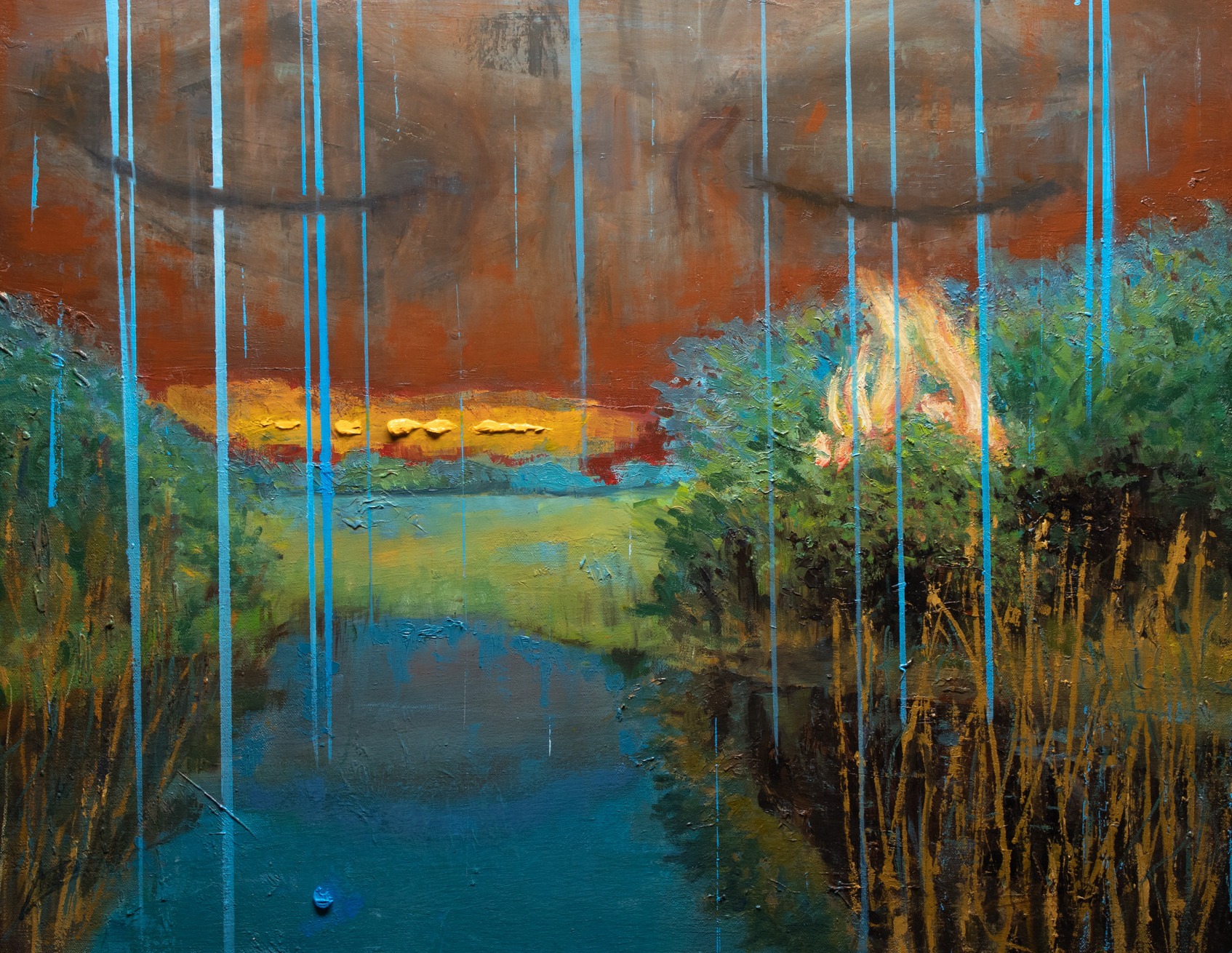
AWAKENING (THE "I AM THAT I AM")
Oil on Canvas | 76cm x 60cm
“The term ‘I am’ denotes one's state of being alive and present. The speaker's ‘identity’ becomes unmistakable.”
Artist's Journal
When Moses encountered God, he received instructions to lead his people to a new land. Upon questioning the identity of the speaker, God responded with the profound statement, "I am that I am."
The significance of this simple sentence is incredibly potent. Initially, one might wonder why Moses didn't seek further clarification or evidence. The term "I am" denotes one's state of being alive and present.
So the first part of the sentence points to the second part which is: “I am” again. It is almost like a circle. Upon closer examination, we can discern: "I am that existence, aliveness, being, life."
For added clarity: "I am that which unites every living creature, the totality of Existence, the Vigour of the Heart, the Pulse of Nature, the ever present all-encompassing Space in every cell and every atom, the crystal clear Consciousness of the mind, the purest Awareness of all Senses, the Presence within Being.”
The speaker's “identity” becomes unmistakable. However, the concise version holds even greater significance, as it also implies that God resides within you.
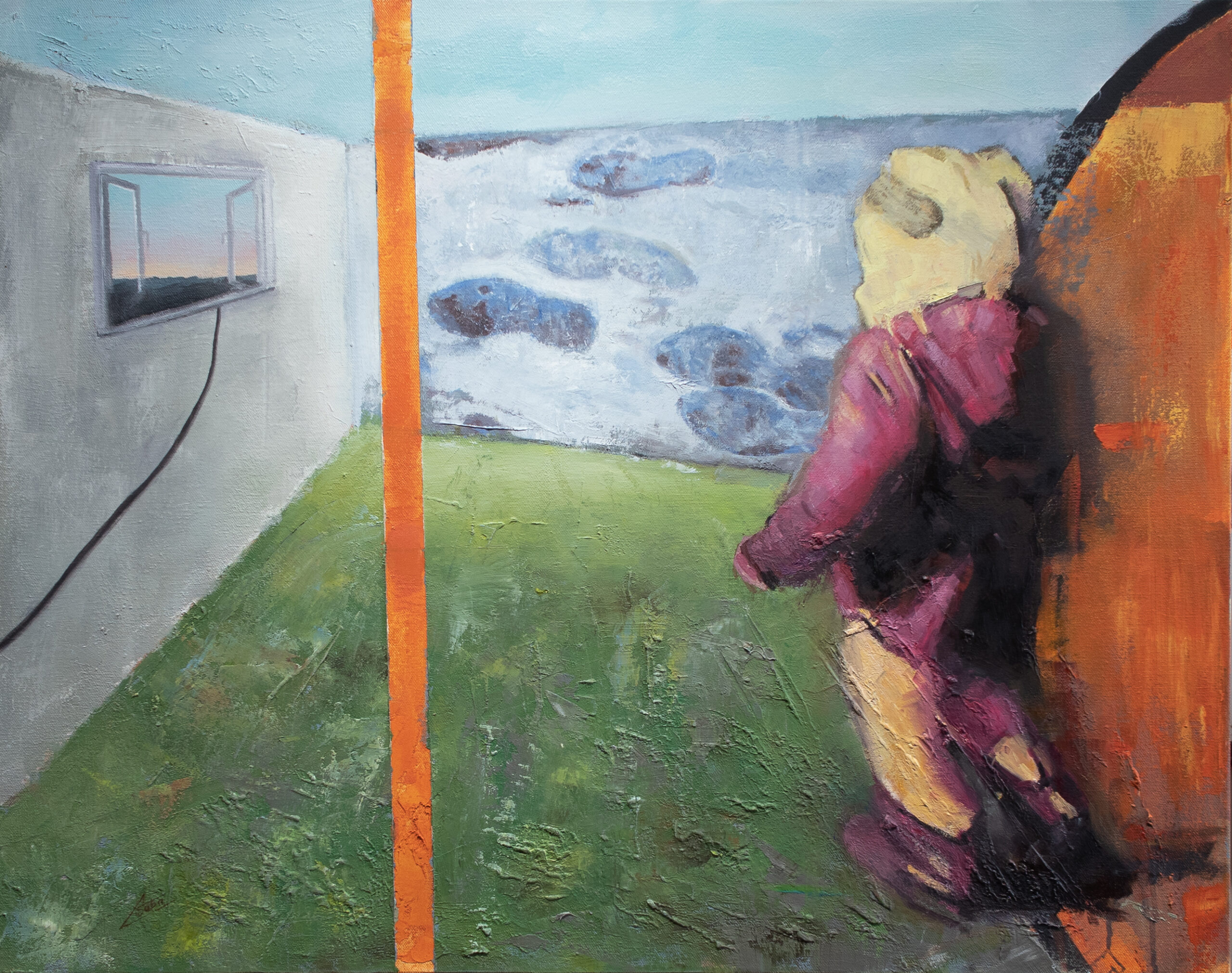
SON OF THE SUN
Oil on Canvas | 76cm x 60cm
“We layer ourselves away from nature; we isolate. But the memory of the sun is still in our cells. We can always return home.”
Artist's Journal
Light is amazing. It gives colour to the painter, warmth to the one who is cold. It reveals the world; it makes the world.
Plants use the sun's energy to build fibres. Animals consume them, and we consume them too (plants advised!). Our main energy is more or less sunlight, turned and transformed. In ancient cultures like Egypt, the sun was the ultimate God. Maybe they understood something we have forgotten.
The little boy in the picture is the next generation. I took a snap on my walk in the neighbourhood while he was running around his mum. The symbol is simple: the boy, like a little astronaut, steps out from the sun, the orange circle.
He sees footsteps frozen on the walls—his ancestors. But they are just footsteps. He might try to understand them, but he has to make his own footprint.
On the floor is plastic grass, because we don't want to mow it. It is always beautiful neon green and low maintenance. He is surrounded by walls, because we love building. The window on the wall is a screen plugged in to show a landscape.
The vertical zip is borrowed from Barnett Newman, who used masking tape in his paintings to define space. I use it here to show that this wall is a fake surface. A constructed reality.
We layer ourselves away from nature; we isolate behind screens and concrete. But this isolation is a choice, not a prison. Nature is our home, and we belong to it. The sun that powers the plants also powers us. We only need to step out from the wall to remember who we are.
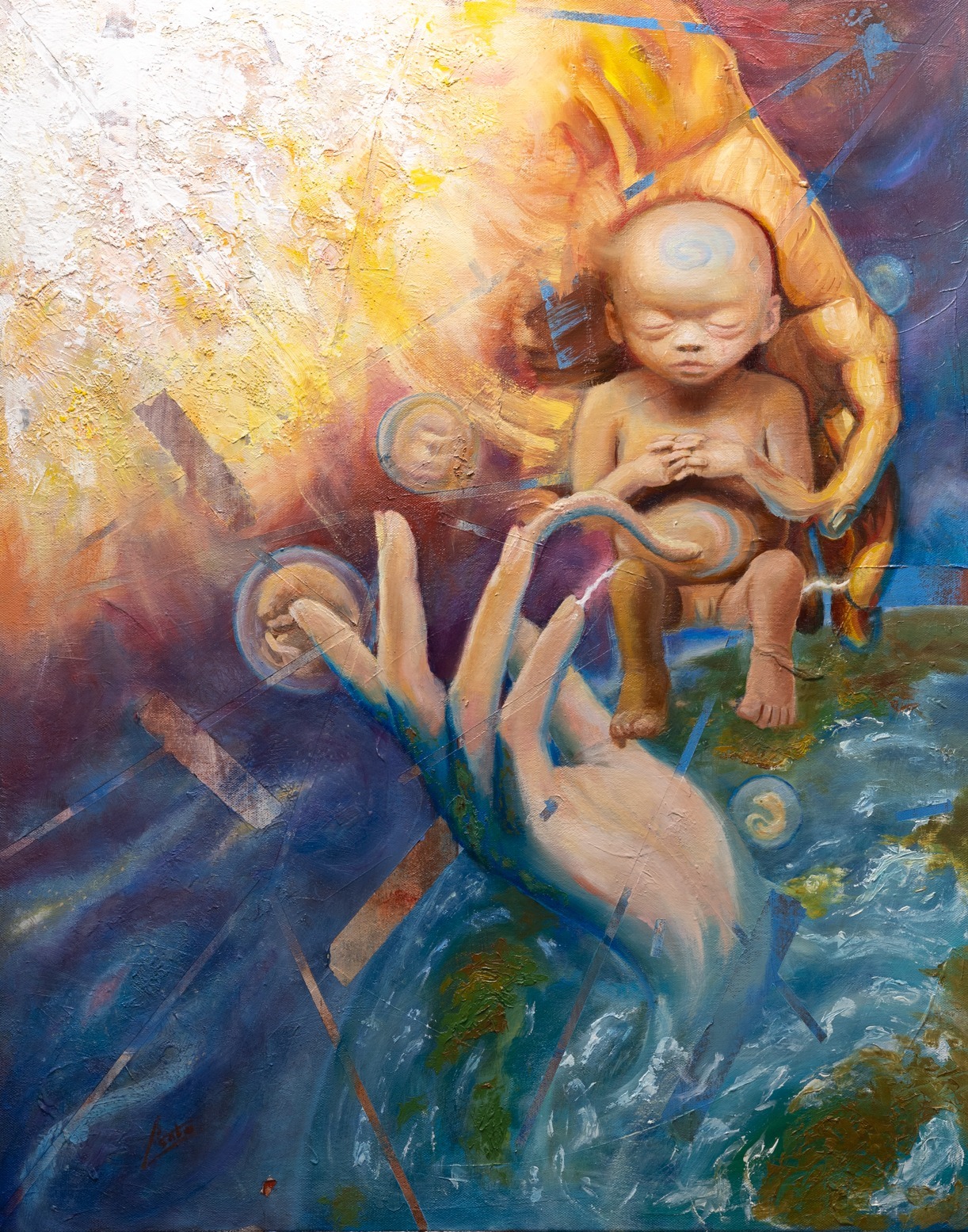
THE COSMIC CHILD BOARDING THE STARSHIP
Oil on Canvas | 60cm x 76cm
“We don’t recognise Earth itself as a spaceship. Whether or not we like it, we are aboard the same ship.”
Artist's Journal
The spark for this painting came from Max Tegmark’s book, Our Mathematical Universe. Near the end, he suggests a profound idea: we often fail to recognise Earth for what it truly is—a spaceship hurtling through the cosmos.
The central figure was inspired by a baby preserved in a bottle at the Hunterian Museum in London. This tiny being had perhaps never drawn a breath. Yet, beyond the sadness of the jar, I saw an all-accepting expression radiating a serene stillness—a tranquil beauty.
In this artwork, the glass walls dissolve. The child transforms into a multicoloured, genderless representation of humanity, surrounded by embryonic bubbles. It captures the precise moment of arrival: a new being boarding the Starship Earth.
For most of us, nothing is more precious than our immediate families—our children, our parents, our partners. They are our world. But beyond these deep bonds, we are all bound to a much older, cosmic parentage: Mother Earth and the radiant Father Sun. Our existence is intricately woven with theirs, a connection shared by all life—humans, animals, and plants.
Whether we realise it or not, we are all crew on the same vessel. We often forget to see the cosmic child that lives within us all—fragile, valuable, and new.
This painting is a visual reminder of our interconnectedness, our shared vulnerability, and the awe-inspiring miracle of life enduring within the vast expanse of the cosmos.
ROOM V: THE WAY OF THE ELEMENTS
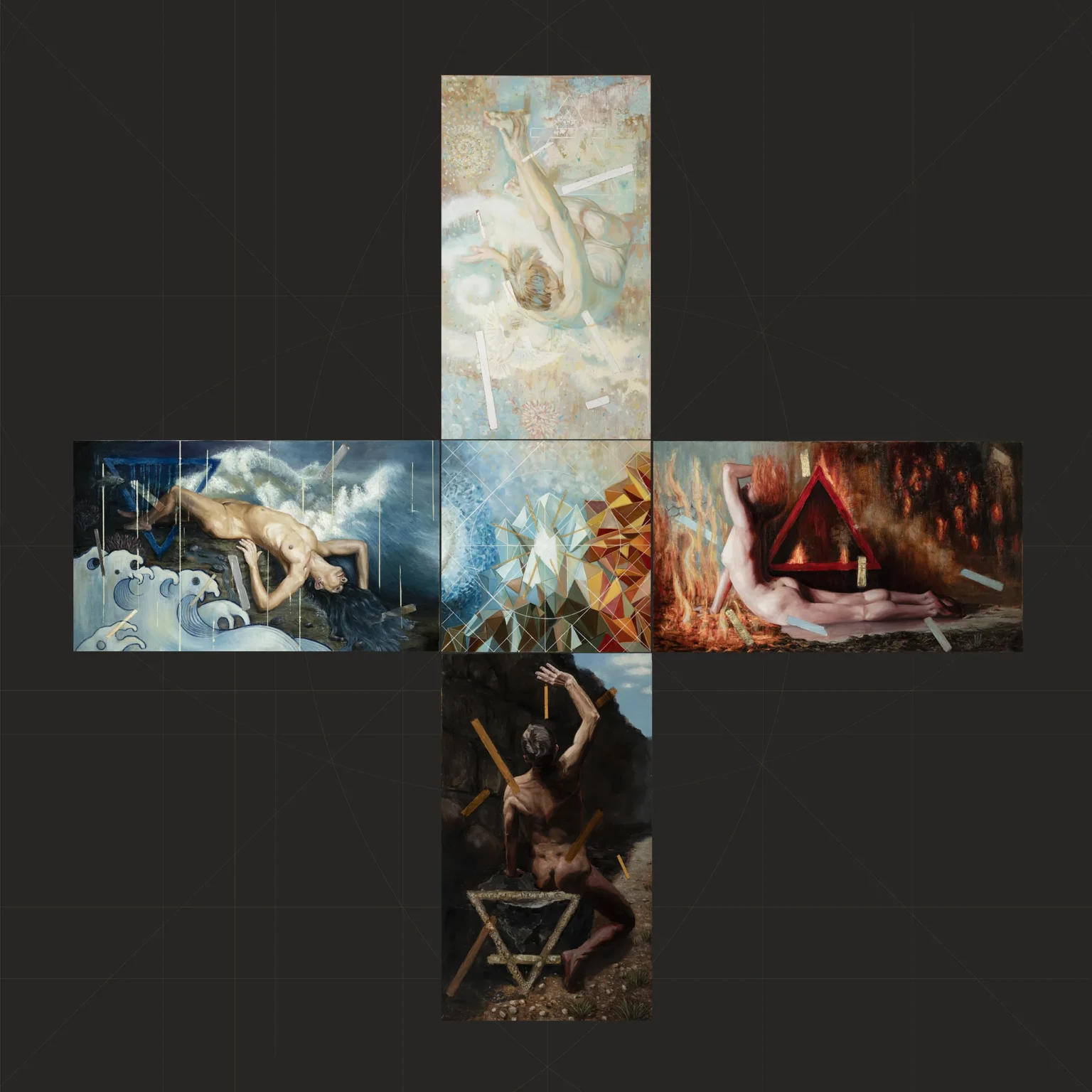
THE ALCHEMY OF BEING
A Cross made of Five Canvases | each 110 cm x 63cm the middle square 65cm x 65cm | Oil painting
Full size: 285cm by 285cm
The inspiration for this painting comes from Sándor Molnár’s book, A Festészet Tanítása (The Teaching of Painting).
Sándor Molnár passed away in 2022. An abstract painter deeply influenced by the renowned Hungarian "literary philosopher" Béla Hamvas, Molnár dedicated his life to charting a progression for artists—a progression in both their skill and their spiritual capacity. In his book, he links alchemy, spirituality, and painting as one continuous life journey.
I used his framework as the foundation for this artwork. Molnár correctly observed that this progression generally follows a chronological bell curve, starting in the heavy earth of youth and dematerialising into the air of old age. However, I have modulated his theory to lift it to a universal level. My intention is to make this progression understandable and applicable to everyone, not just painters. It is a linear progression in age, but it is also a cycle we navigate when life events confront us, working through the elements as a way to process and cope.
Painting is, in essence, a form of alchemy. Colourful minerals and oil bind tightly together on a surface to transform into an image. The artist’s hopeful intent is to evoke a sensation or an idea in the viewer—the very same sensation the artist personally experienced. There is a clear transition from the tangible to the intangible, leading to meaning or emotion. It makes no difference whether it is representational or abstract art. This is the magic of art.
The human body is an alchemical wonder. We carry the four elements—earth, water, fire, and air—within our bodies. Without them, we could not live. Water makes up 60% of us. Fire acts as the slow burn when we process food, turning it into energy. We return that fuel to the earth when it is eventually disposed of. Air is our primal energy source, providing the oxygen to fuel our inner fire.
Through the characteristics of these elements, Molnár brilliantly linked this biological reality to a spiritual progression. We start in the earth, move to water, then to fire, and finally to air. It is a hero’s journey through the elements. He originally placed a crystal element between the fire and air stages; however, I have moved this crystal to the centre, surrounding it with the others. In life, the relentless stream of events throws us up and down. These highs and lows feel uncontrollable, and consciously or unconsciously, we yearn to find a centre.
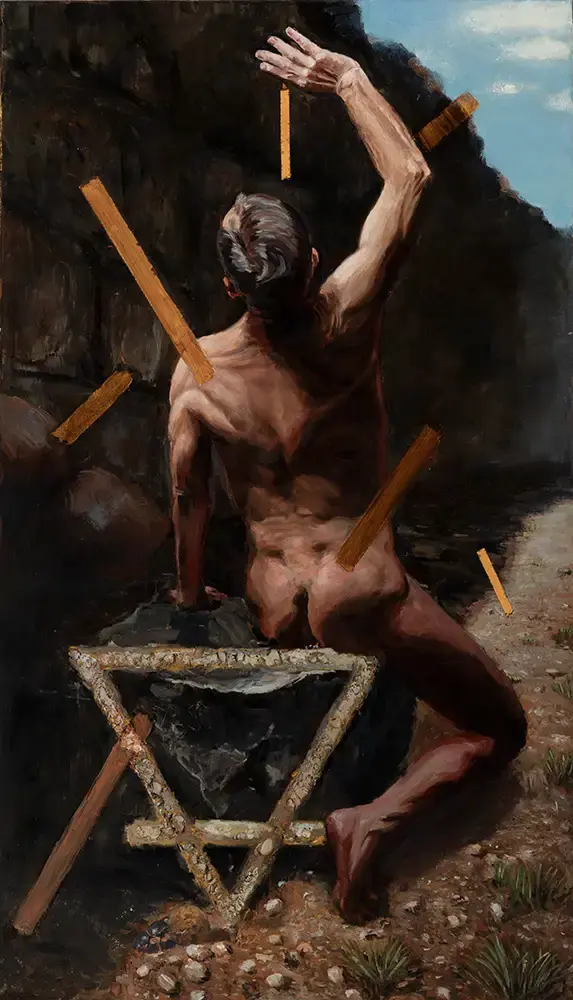
THE EARTH
In the earth element, we are bound to the material aspect of life. Earth is heavy. It is solid, dry, rough, and opaque. Even in its finest form of sand or dust, if it sticks to the skin, we try to wash it off.
Everything here is concrete. Our reality narrows to achievements and the sheer, exhausting effort required to control the material world. We transform will into action, working hard towards goals.
Time is seen solely as a linear progression towards desired outcomes. We dig in. We move the earth. It is relentless, tiring labour. Yet, as we work with this element, creativity flourishes.
The earth element is the ground, the starting and stabilising point not just for plants, but for us. We are bound to it by gravity, which provides a sense of security and a sort of "permanence"—the stones and the mountains feel eternal.
Many never wake up from this stage; they spend their entire lifetime immersed in the earth.
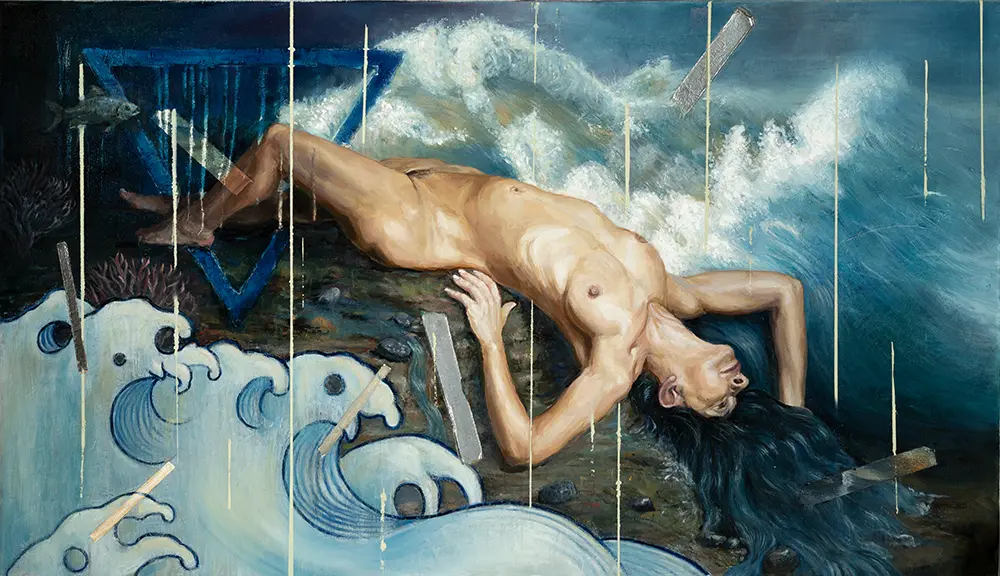
THE WATER
As we develop further, the heavy earth is diluted. It becomes fluid and wet. Water is transparent, moving, and reflective. Primarily, it moves downwards and horizontally, relentlessly seeking the lowest point.
It takes the form of that which surrounds it: the water in a glass is tall, but on the table, it is flat. Life originally started from water before conquering the earth, and many lifeforms broke away from it.
We humans are born to earth, and first we need to find our way back to water.
If you leave a glass of water on a windowsill, within a few days, microorganisms will appear.
In the water element, we explore philosophical changes. We sense that something else exists beyond the material—events or forces that defy a purely material mindset. As water naturally streams downward, it carries the earth, washing and cleansing.
We open up spiritually, but hit many dead ends. Our philosophy and beliefs shift and turn in different directions. The imagination grows wider and perhaps wilder, but from the messy depths of the water—the shadow of the unconscious—demons and monsters can surface.
Yet, with time, water settles. We find clarity as the sediments sink to the bottom. The reflective and transparent quality comes forward. Eventually, it evaporates, leading us to fire.
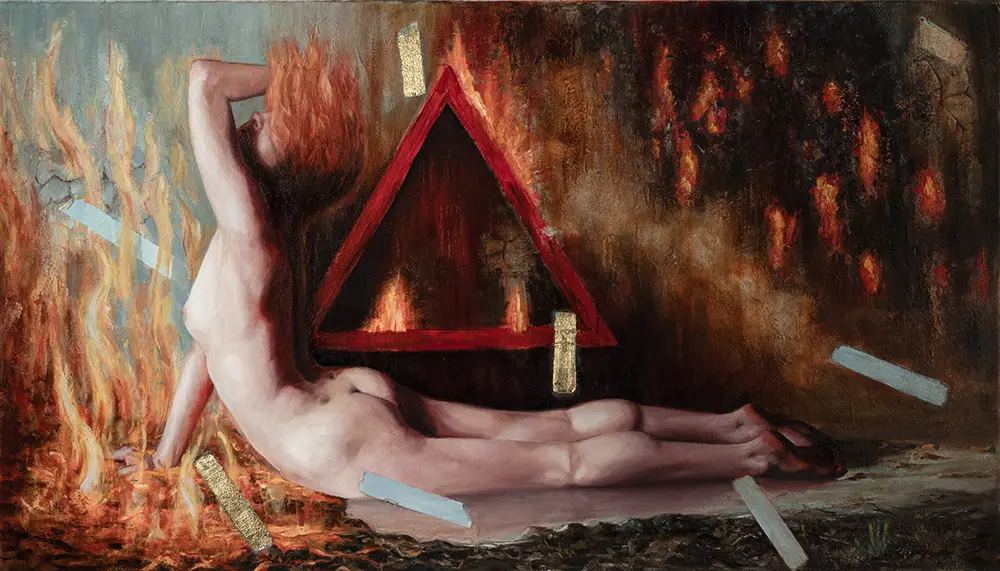
THE FIRE
Friction ignites. This is the crucible for immense and lasting transformations. While water pulls us horizontally into shifting depths, the fire stage forces our energy vertically upwards. The things we took for granted fall apart. They burn, and it hurts. We burn out.
Repeated pleasure-seeking eventually exhausts itself, hitting a wall. Having drained our outward-going vitality and finding no lasting refuge, the energy has nowhere else to go but inwards. It can also be triggered by profound suffering when life defies our will. Feeling a deep sense of unfairness, we breed further pain until, finally, the trajectory turns upward.
Our attachments loosen. Everything turns to smoke, leaving residue back on the earth. Our body changes; teeth and hair fall out, the skin loses elasticity, and eyesight weakens. Impermanence strips the glaze from our constructed reality. The vibrant pigments of our youth fade, and we must accept the inevitable scraping away of the ego.
With the removal of attachments, we realise that we constantly create new identities for ourselves, but they do not last—they burn too. We give up roles, things we thought granted forever leave us, and we rethink our identity. In the final burn of this stage, our identity is revealed to be far less solid than we believed. In this existential crisis, an understanding ripens.
Despite the pain, beyond this destruction, the fire emanates a huge amount of energy. This element is the most transformative. A release is happening.
We discover that the ego is an attachment too, and while it never actually disappears, its authority fundamentally changes. It no longer rules. Time reveals itself as the now, and space as the here. Thinking turns to the inner body, exits, and stops there momentarily; we discover the mind has many layers, but when all the layers are lifted, there is something underneath.
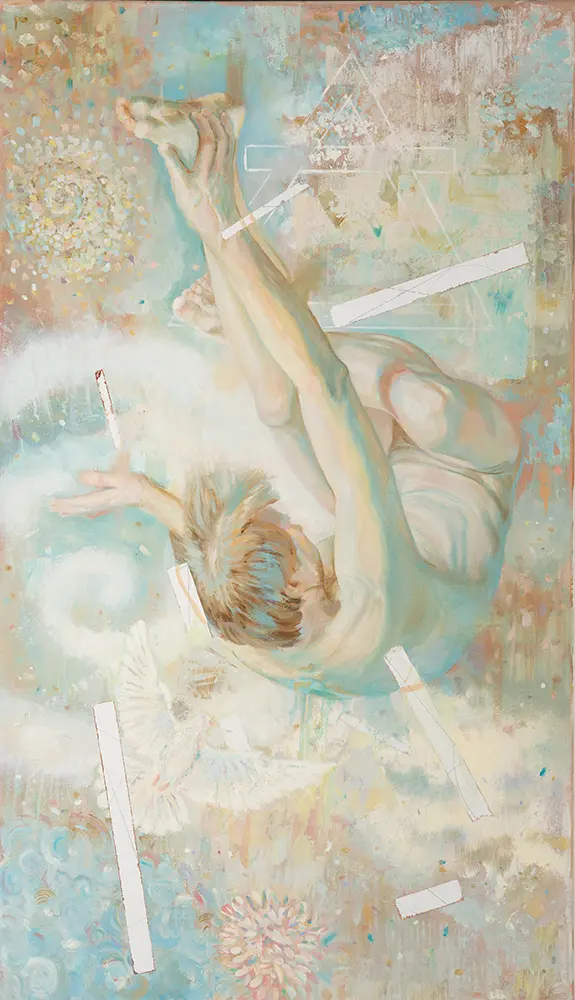
THE AIR
In the smoke and ashes, the final stage of the cycle appears: Air. Here, form becomes formless; darkness becomes light, heaviness becomes weightless, and limits expand. The mind falls silent and listens to the body, and the material becomes ethereal.
The air is limitless and invisible; it is boundless space. Because it moves invisibly, the thinking mind often ignores it as “empty”, only becoming aware of it when it moves as wind or carries a scent. But if it were truly empty, we could not breathe, and birds could not fly—they push themselves upward against the very particles of the air.
In art, this stage belongs to pure abstraction—the complete dissolution of form and representation. In human life, it is dematerialisation and emptiness. To the thinking mind, “emptiness” sounds terrifying, like a pointless, dead vacuum. Yet, paradoxically, it is exactly this resting point that our minds long for.
It is from this 'No-Thingness' that all life is born and return, that we yearn to connect with, and where we find rest. It is not a void, but a saturated emptiness— full of everything in a formless form, a profound spaciousness containing the totality of existence in an unmanifested, continually revealing itself in the now as the manifested. This is the raw energy of aliveness.
The presence expands, and the centre is brightly revealed as clear consciousness. Attachment-less, and free from judgment. It is the practice of Presence. Deepening this turns into boundless compassion and loving-kindness. In Zen, this is the goal of goallessness. It is the touch of the innermost, deepest layer ⇒ the Being Layer.
This is the final stage of the hero, who turns inward and dissolves into themselves yet everything remains the same.
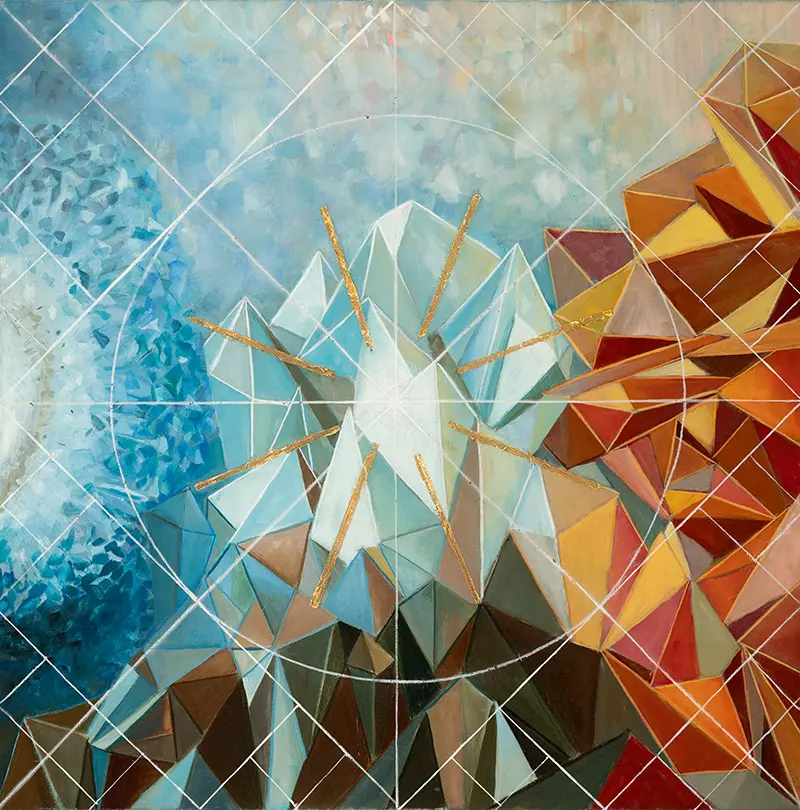
The Crystal and The Cross - The Point of Stillness
The central crystal of the cross symbolises a profound and simple understanding that transcends time.
In geometry, a cross is the meeting point of two lines, marking out a single, point—a centre. Now, staying with geometry: the square shape operates on a 1:1 ratio, the basis of our measurement. Yet, the diagonal of that 1:1 square is √2. It is an irrational number because its decimals carry on into infinity. Therefore, the rational and the infinite irrational are already present in one single unit. To expand on this, I added the circle to represent the irrational curve, introducing the number π. This combination creates a unified whole.
But there is another observation we can make here: this intersection is also the meeting of the inner and the outer world. While it sounds conceptually profound, finding this central point does not actually happen in our thinking mind; it happens in our body. It is our immediate, sensible, direct reality. We can touch it simply by focusing our attention on sensing our inner body. This is the basis of all mindfulness practice. It is pure Presence.
This vital presence is frequently unveiled beyond the vast suffering of the Fire element.
In nature, a crystal forms within all elements: deep down in the earth under tremendous pressure, in water as crystallisation, and in fire through cooling magma or alchemical calcination. It is a refinement over pressure, heat, and chemical reaction. The atoms take perfect geometrical order, becoming transparent. Light passes through them while maintaining their solid nature.
The diamond, our most valued gemstone, embodies this perfection. It is transparent, reflective, yet the hardest of all materials.
Therefore, the crystal element is the moment when this entire journey is clarified and understood, like a sudden, unexplainable awakening. And so, crystallisation begins. It is revealed as the Being Layer, and our ever-changing identity finally shifts here.
After this "Crystal moment", the cyclic journey can repeat itself, not just over a lifetime, but in a single arising situation (Earth) that triggers assumptions and emotions (Water). This can burst out as a reactive energy (Fire), but with awareness, it silently burns out, returning to presence (Air). Life continues.
Worldly events, reactions, and effects still occur, but they are navigated with the new authority of the Being Layer. The duration of this cycle could be a mere few minutes. Even if this awakening eludes us during our lives, the cycle will inevitably complete itself in the moment of death, as the material dissolves into the formless.
A point has no dimension. Whether the lines converge into the centre or emerge from it, the intersection dissolves the dimensions entirely—yet contains the possibility of all directions. Paradoxically, the point is knowable.
This Awareness is defined in a single point that is accessible to us not just conceptually but experientially. This is our unprocessed, witnessed direct experience, not as a “me” or a “mine,” but as presence. It is aliveness in the now, where life actually happens, independent of our thoughts.
I chose to use human figures on the cross because it is a visual representation we have been familiar with for centuries, and the human form resonates with us most easily. It grounds the philosophy in the human condition.
The cross is a symbol marking a point. And that centre point wants to be found in our being as peace.
Life, as we experience it, is a relentless stream of events. Our minds are in constant use—predicting, plotting, and analysing the highs and lows—yet this fast pace takes its toll. We naturally yearn for time to process and settle. When we touch this centre, it grounds us. The mind is finally allowed to slow down and find relief, as we momentarily step into Presence.
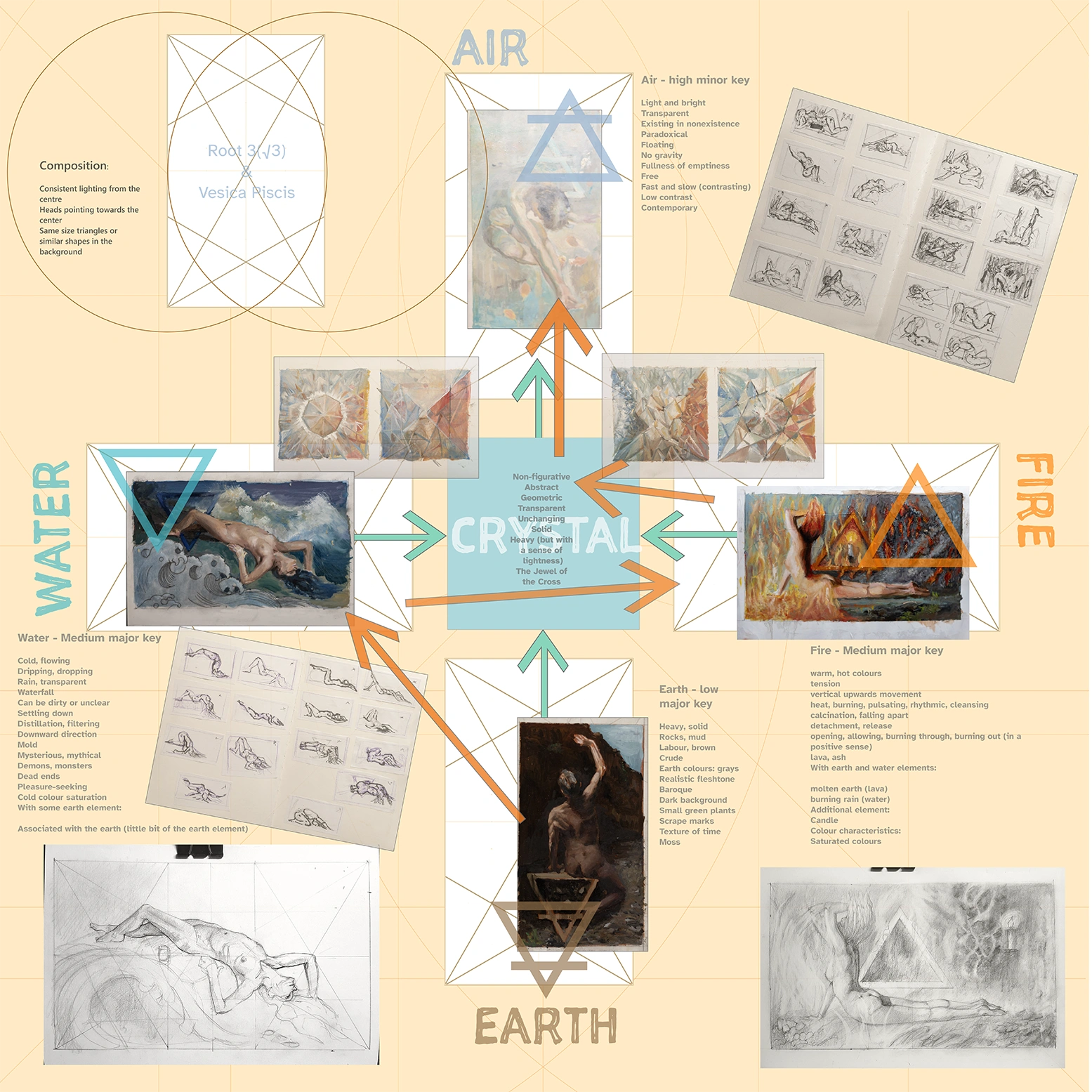
The Blueprint (digital)
The Physical Canvas I.
To capture this profound spiritual awakening on a physical plane, the canvas itself had to become a deliberate vessel. This artwork occupied my mind, my easel, and my hands for two years—rethinking, repainting, and readjusting. I focused on one element at a time, but in the painting phase, the canvases became responsive, developing almost of their own accord.
The Geometry When I began constructing this piece, I realised standard dimensions would not suffice; the geometry had to structurally hold the philosophy. I chose the ratio of the Root 3 rectangle (110cm by 63.5cm) for the outer panels, an aesthetic the old masters used to perfectly balance the human figure. In philosophical geometry, the Vesica Piscis—two intersecting circles of the same radius, where the centre of each lies on the circumference of the other—always yields this precise Root 3 ratio. The almond shape between them is the womb of creation. In Pythagorean theory, the One (Monad) becomes two (Dyad)—a physical bridge where duality is born, and ultimately returns to unity.
The central canvas demanded a different logic. I built a 65cm by 65cm square. Our human mind operates on this 1:1 logic; we square things up, we make the world right-angled, black or white. Yet, the universe is rounded, curved, infinite, and graduated—better represented by the circle. To unify the square with the infinite curve, I had to physically pull a perfect circle within it. It was a challenging task. I fixed a small wooden block with a screw and traced the line with a wire attached to the screw and my brush. My knees did not appreciate getting in touch with the Earth, but the central crystal unified these two qualities.
The Materials To make the alchemical link even stronger, I combined reflective silver (aluminium foil) in the water element, and gold (copper leaf) in the fire element.
- Earth: I glued stones and charcoal pieces into the Greek symbols, giving it a visceral texture. Using heavy browns, muted reds, and warm greys, I made it the darkest of the four, as the journey starts from darkness and moves towards the light. The perspective has an upward slant, but the figure reaching towards the middle crystal signals the direction we are moving.
- Water: For the background water, I referenced a moving seascape from the V&A Museum, and included an ancient Japanese water design in the foreground. To enhance the surrealism, the figure's hair turns into cascading water, with a fish swimming in the shadows. The vertical lines symbolise falling rain.
- Fire: Both poses for Fire and Water were chosen for the direction the elements naturally move: down and up. In the top right corner, textural elements show pulsating, glowing red cracks ready to burst into flames. The saturation and contrast are high, finished with copper leaf. Like flames, her hair moves upward, defying gravity.
- Air: For this part, I could have simply left the canvas empty, but I wanted to represent it with a figure that is changing colour and fading out, becoming light. To manifest weightlessness, I turned the reference photo upside down, removing gravity. I applied the paint in pale, scumbled washes, so the colours breathe through the pigment. I started by breaking the palette down to the primary colours—red, yellow, and blue—and painted a layer with each colour: first red, then yellow, and finally blue. I capped each at a higher value, reducing the contrast and making them muted. The inspiration of the French painter Odilon Redon is very visible here. Brightness is turned up, saturation is reduced, and the colour range is the widest. With small brush marks, I tried to symbolise the form falling apart, as if the particles were escaping.
- The Crystal: Molnár’s crystal and Śūnyatā (emptiness) paintings are masterpieces that no one will outdo. Inspired by those, I attempted to create triangular surfaces here to imitate the crystal's nature. One point is just a point, two is a line, and three is a surface—a triangle, a primal shape. Tuning the colours coming in from the four directions was a profound challenge. Trying to pull straight lines with oil paint and a ruler taught me a lot. The radiating golden lines shining from the middle were highly problematic. Copper leaf did not want to be straight, and random particles stuck to the canvas, giving an extra, unpredictable shine that I eventually surrendered to. The result is a perfectly imperfect jewel of the cross.
The Physical Canvas II.
The masking tape marks left on the canvas are intentional; they reveal an underlying layer. The tears of the tape look like a wound or a scar on the painted surface, echoing that we all carry wounds and pain, but suffering is optional.
I have not used a chronological age timeline for the figures. They represent various ages, balancing the male and female aspects of the human experience. The composition, with the figures’ heads directed towards the central crystal, is intentional. We long to be grounded, to find a centre. Through an understanding (the concept), we turn to our direct experience in the body (engagement) to embrace the saturated fullness of the spaciousness of nature.
Finally, my deepest respect and appreciation go to Molnár for devoting his life to showing us this cycle. His words touched me profoundly, and his lifework shines.
My aim is for this concept to enhance or provide a new perspective on his vision, not to misrepresent it; or, put another way, I’ve taken his idea and evolved it in a new direction.
Although this is a lengthy piece of writing, these are just letters, words, and concepts accompanying the painting; they are only ideas to explore and finding in yourself.
Studies for the painting
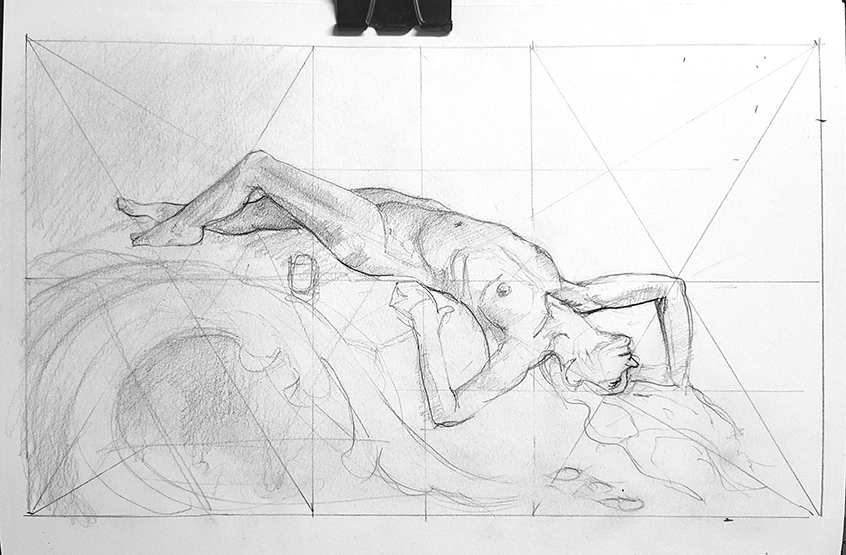
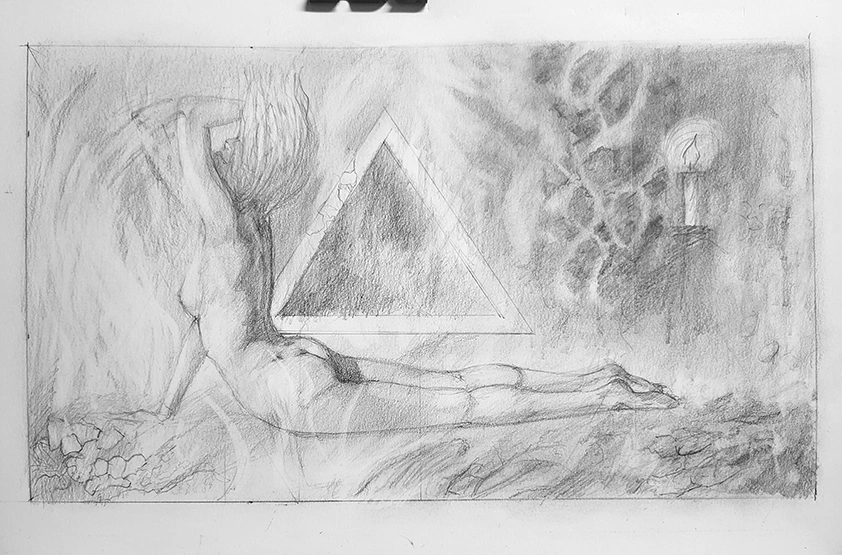
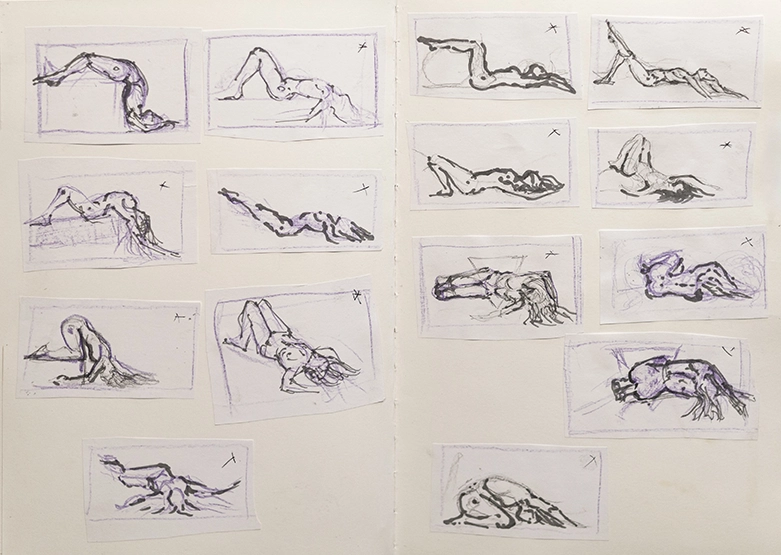
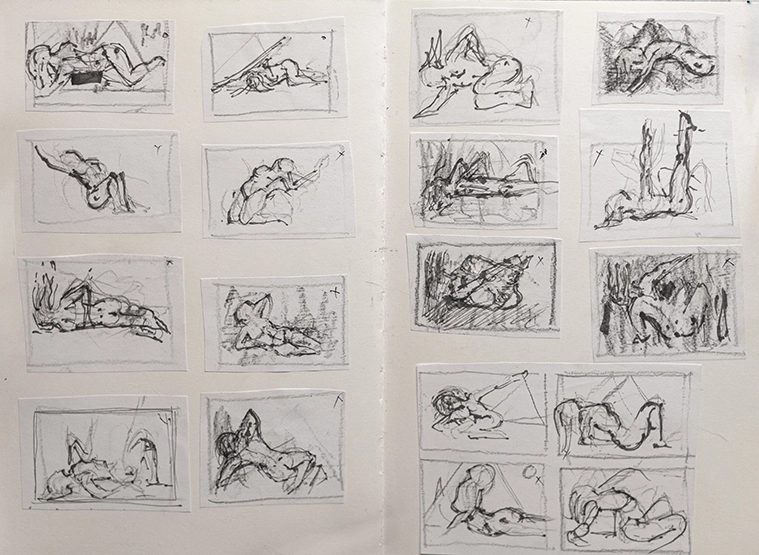
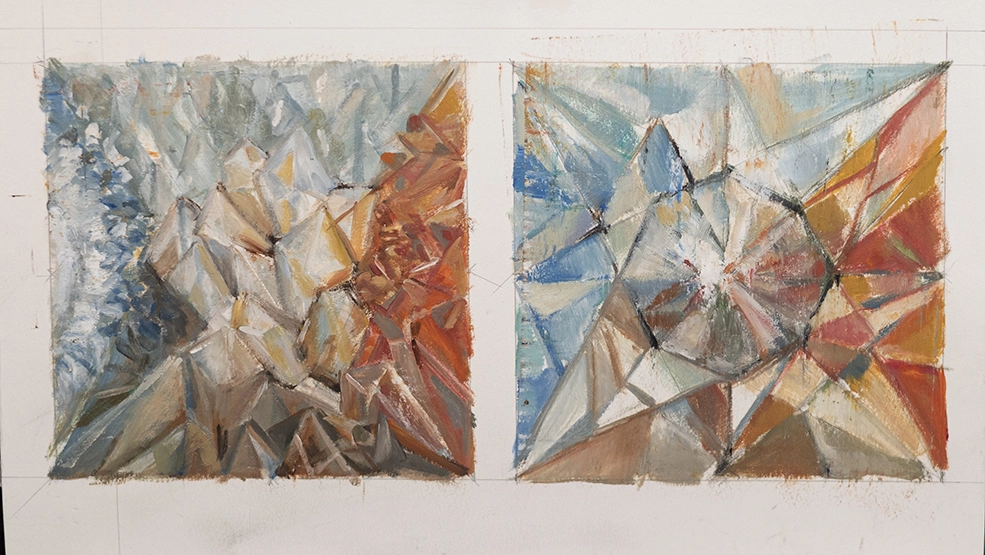
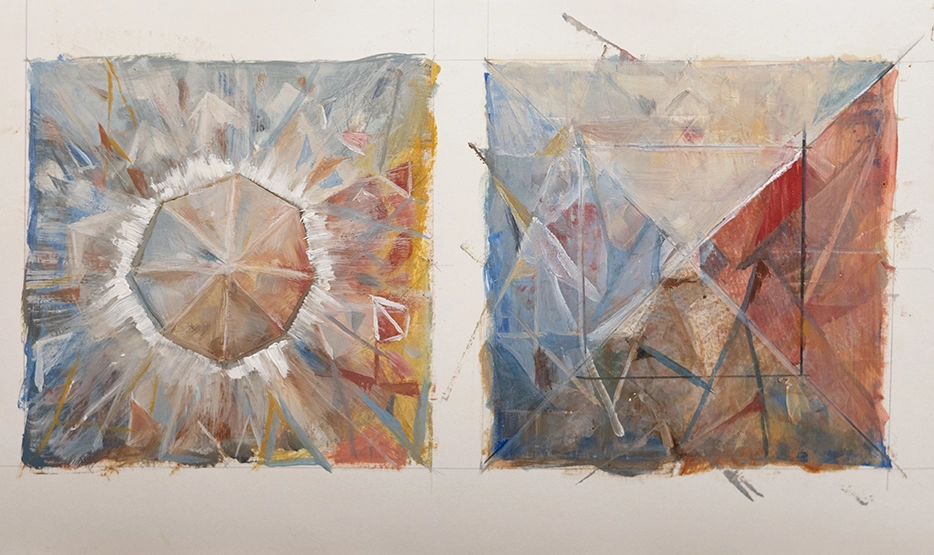
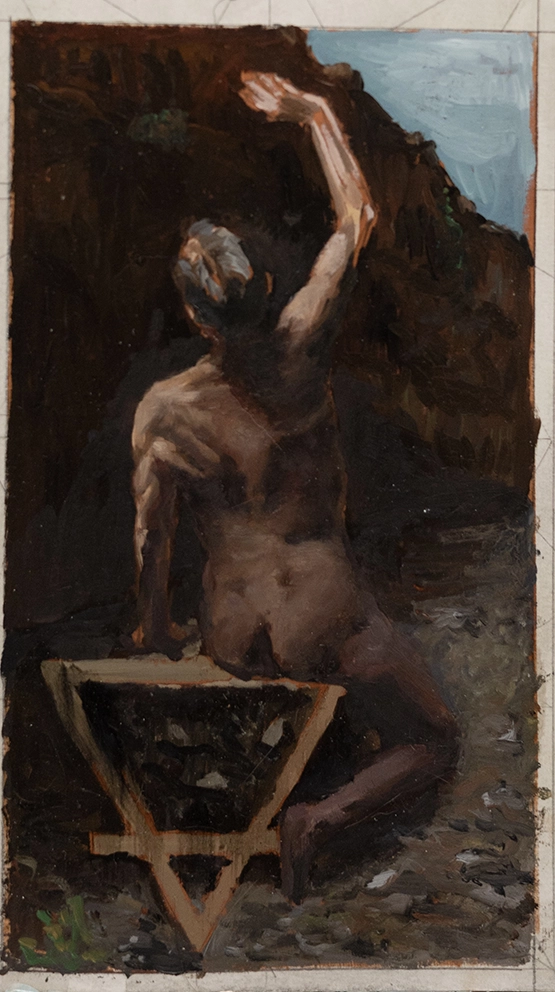
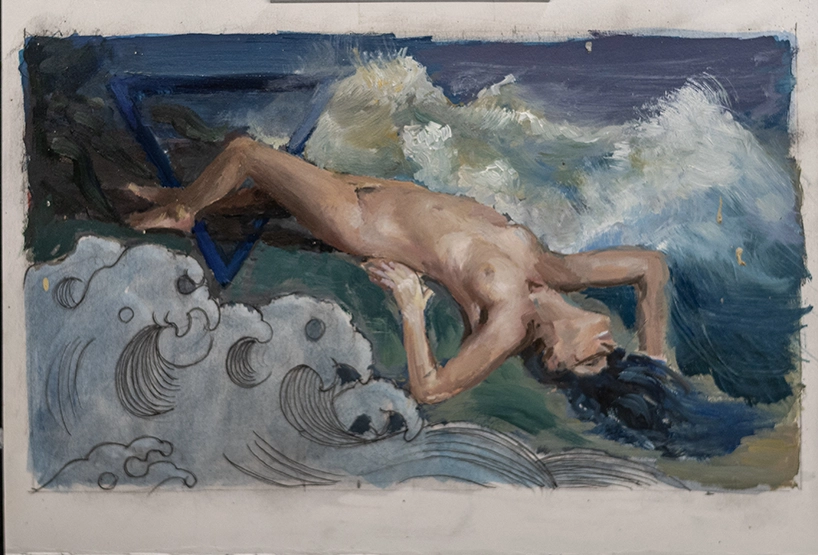
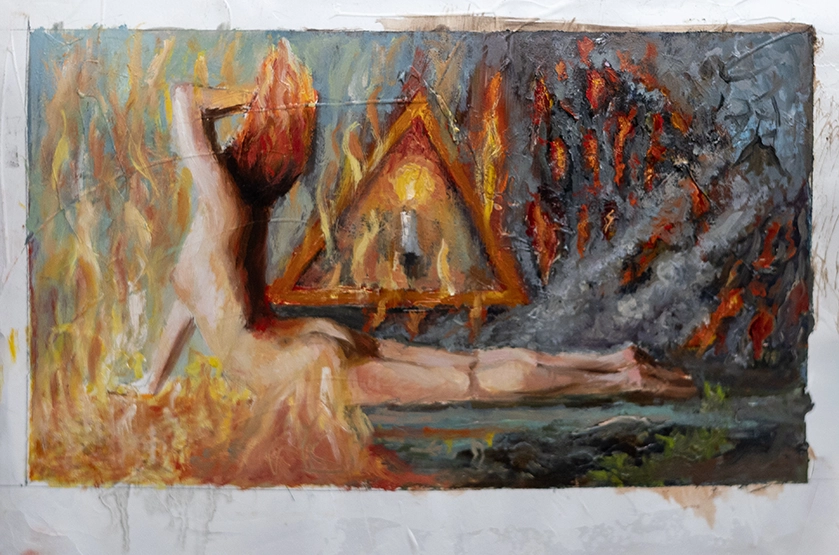
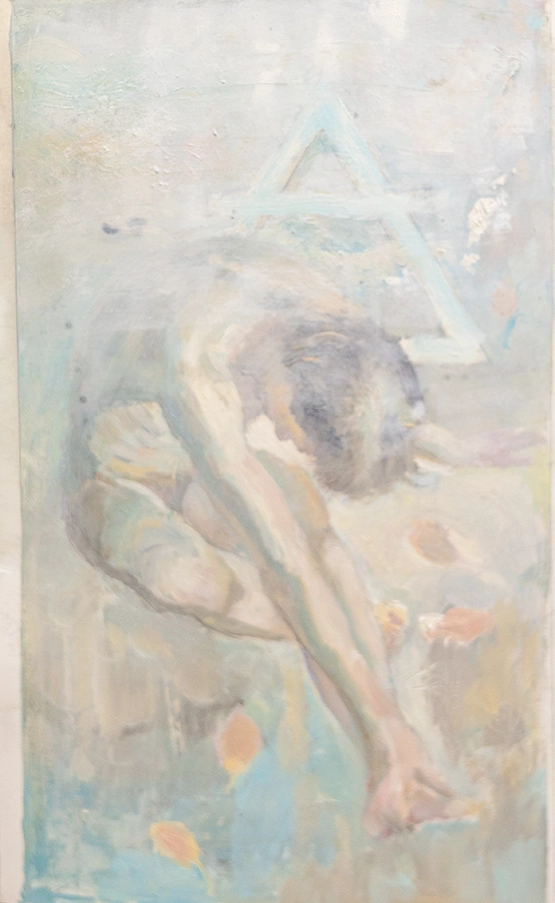
Where the paintings begin
These studies are where The Alchemy of Being started: drawing the figure from life. If you’d like to learn that foundation, I teach it on The Artist Roadmap 2027, a life drawing course on Monday evenings in Milton Keynes, starting in January.
It is worth noting that this progression is not a race or a goal, nor is the Air element a destination. Life, in its natural course, will move us through these stages. The true wisdom of this cycle lies in finding the crystal element (it can be reached from all the elements)—our grounding presence—in the midst of our current reality. By anchoring ourselves in this centre, we can live authentically in the present, allowing life to naturally and gracefully transition us toward the lightness of air. Yet, once crystallisation occurs, this entire progression can also unfold as a cycle of mere minutes with each situation arising.
"If you awaken from this illusion, and you understand that black implies white, self implies other, life implies death - or shall I say, death implies life - you can conceive yourself. Not conceive, but feel yourself, not as a stranger in the world, not as someone here on sufferance, on probation, not as something that has arrived here by fluke, but you can begin to feel your own existence as absolutely fundamental. What you are basically, deep, deep down, far, far in, is simply the fabric and structure of existence itself."
Alan Watts
You have walked through the gallery of my mind. You have seen the chaos of the world, the struggle of the self, and the quiet hum of the universe that lies beneath it all.
These paintings are not just images; they are questions hanging on a virtual wall. They are invitations to stop drifting and start seeing.
The virtual experience ends here, but the reality is yours to create. If something here resonated with you, if a piece of art spoke to that quiet space inside you, know that these works exist in the physical world. They have texture, weight, and a presence that screens cannot capture.
Thank you for walking this path with me.
Csaba Tibor Palotas ONE ART STUDIO
Beyond the gallery
These paintings point to presence. If you’d like to practise it, not only look at it, I teach a small six-week course: The Practice of Being. Live online, body first, never more than eight people. The next course starts in January.
